
Ensuring your devices work in Denmark requires knowledge of local outlets and voltage compatibility....


Travel Guides
Costa Rica uses Type A and Type B plugs, the same flat-pin outlets used in the United States and Canada, with 120V electricity at 60Hz. If you're coming from the US or Canada, you don't need a plug adapter or voltage converter. Travelers from the UK, Europe, and Australia will need a plug adapter, and should check whether their devices require a step-down voltage converter.

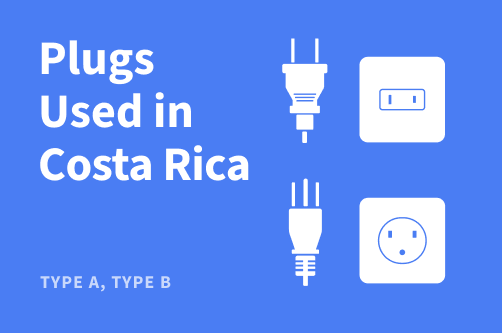
Costa Rica is one of the easiest countries in the world to travel to from the US when it comes to electricity. Same plugs, same voltage, same frequency - your chargers work the moment you walk into your hotel in San José.
But if you're arriving from Europe, the UK, or Australia, you'll discover that none of your plugs fit. I watched a British couple at a hostel in Manuel Antonio try to jury-rig their phone charger into a wall socket with a pen. It didn't work.
Here's everything you need to know about Costa Rica's plug types, which adapters to buy, and whether you'll need a voltage converter.
Costa Rica uses Type A and Type B plugs. These are the same flat-pin plugs used across the United States, Canada, Mexico, and most of Central America. Here's the difference between the two.
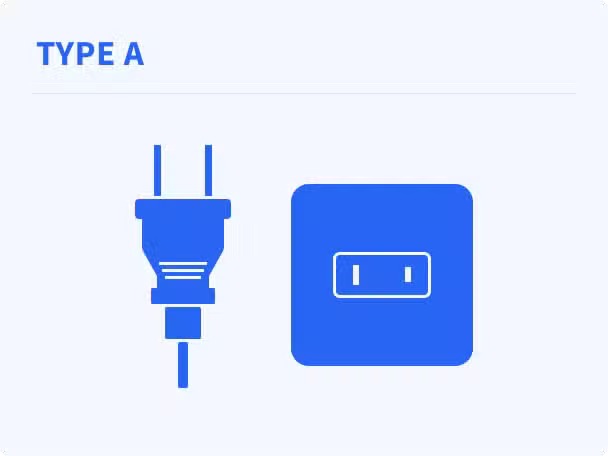
Type A plugs have two flat parallel pins. They're ungrounded, meaning there's no third pin for an earth connection. You'll find Type A on smaller devices like phone chargers, laptop adapters, electric razors, and most two-prong appliances.
Type A is the most common outlet you'll encounter in Costa Rica, especially in older buildings, budget hostels, and rural eco-lodges. Many Type A sockets in Costa Rica are polarized (one slot is slightly wider than the other) which means some plugs can only be inserted one way.
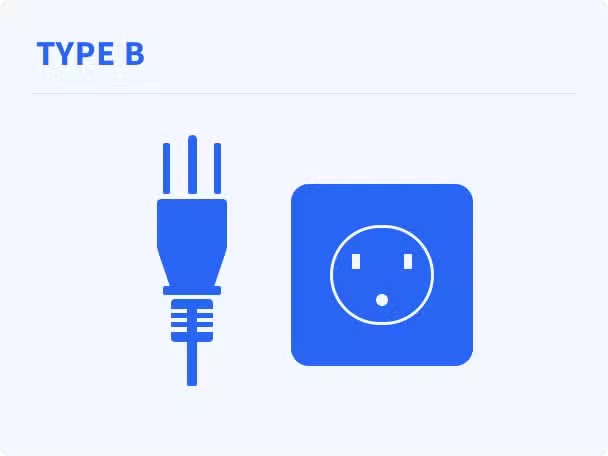
Type B plugs have the same two flat parallel pins as Type A, plus a round grounding pin below them. This third pin provides an earth connection for safety, which is why you'll find Type B on higher-power devices like hair dryers, desktop computers, and power strips.
Type B sockets accept both Type A and Type B plugs. So if you're carrying a mix of two-prong and three-prong US devices, a Type B outlet handles both.
Newer hotels, resorts, and vacation rentals in Costa Rica increasingly install Type B grounded sockets, though you should still expect to find ungrounded Type A sockets in many locations (particularly in older construction outside San José).
If you're traveling from the US or Canada, you almost certainly don't need an adapter, your plugs already fit. But if you're coming from the UK, Europe, Australia, or anywhere else that uses different plug types, buying an adapter before your flight is the smart move.
While you can find adapters at electronics stores and shopping malls like Multiplaza Escazú in San José, selection is limited and airport options have been inconsistent, carrier kiosks at Juan Santamaría Airport come and go.
Here are the best options to buy online:
The EPICKA covers over 200 countries and includes four USB ports plus an AC socket. For Costa Rica, it converts your UK, European, or Australian plug to fit Type A and B outlets. Retractable pins keep it compact for packing. If you're continuing to other Central American countries or beyond, this one adapter handles them all.
The TESSAN features 65W GaN-powered charging with multiple USB-C and USB-A ports. Ideal if you need to charge a laptop alongside your phone and camera. It covers 150+ countries and includes overload protection and temperature control. The US/North America configuration works for all of Costa Rica's outlets.
Ceptics adapters come with Quick Charge 3.0 USB ports and often include a travel pouch. They sell country-specific adapters that are lighter and cheaper than universal ones.
For Costa Rica, look for their "North America Adapter" which handles Type A and B outlets. Good option if you want something compact without the bulk of a universal adapter.
If you just need a straightforward plug converter with no USB ports or extra features, the Amazon Basics North America adapter gets the job done. Lightweight and cheap enough to throw a spare in your bag. Works with both Type A and Type B sockets throughout Costa Rica.
Costa Rica runs on 120V at 60Hz. Whether you need a voltage converter depends entirely on where you're traveling from:
Coming from the US or Canada?
You don't need anything. Costa Rica's voltage (120V) and frequency (60Hz) are identical to the US and Canada. Your devices will work exactly as they do at home. No adapter, no converter – just plug in.
Coming from the UK, Europe, or Australia?
Your countries use 220–240V, which is significantly higher than Costa Rica's 120V. Most modern electronics are dual voltage (100–240V) and don't need a converter. Check your charger's label. If it says "INPUT: 100–240V," you're fine with just a plug adapter.
But single-voltage devices rated only for 220–240V (like some European hair dryers, curling irons, or electric kettles) will not work properly on Costa Rica's 120V supply.
They won't be damaged (unlike plugging a 120V device into 240V), but they'll run at severely reduced power: a hair dryer will barely produce warm air, and a kettle will take forever to boil. You'd need a step-up voltage converter, or just use what your hotel provides.
There are four main ways to get internet access in Costa Rica:
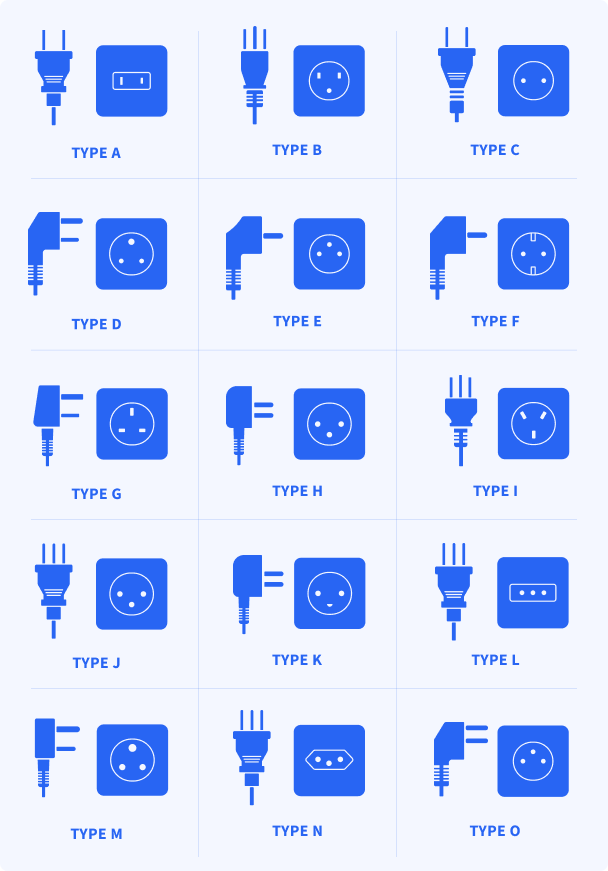
Costa Rica makes things simple for North American travelers, it's one of many countries in the Americas that adopted the US-style plug standard. Globally, there are 15 different plug types labeled A through O.
Here's where the major plug types are used:
| Plug type | Countries |
| Type A & B | United States, Canada, Mexico, Japan, Costa Rica, most of Central America |
| Type C | Most of Europe, South America, Asia |
| Type D | India, Nepal, some African countries |
| Type E | France, Belgium, Poland |
| Type F | Germany, Netherlands, South Korea, Austria |
| Type G | United Kingdom, Ireland, Singapore, Malaysia |
| Type H | Palestine, Israel |
| Type I | Australia, New Zealand, China, Argentina |
| Type J | Switzerland, Liechtenstein |
| Type K | Denmark, Greenland |
| Type L | Italy, Chile |
| Type M | South Africa, Lesotho |
Costa Rica shares its plug type (Type A and B) with the United States, Canada, Mexico, and the rest of Central America. If you're planning a multi-country trip through Panama, Nicaragua, or Guatemala, the same plugs work everywhere.
Planning to visit other destinations in the Americas? Check out our guides on Mexico plug types and Brazil plug types.
Yes. Costa Rica uses Type A and Type B plugs, which are identical to those used in the United States. The voltage (120V) and frequency (60Hz) are also the same. US travelers can plug in their devices without any adapter or converter.
No. The UK uses Type G plugs with three rectangular pins. Costa Rica uses Type A and Type B with flat parallel pins.
British travelers need a plug adapter. Most modern UK chargers are dual-voltage (100–240V) and will work fine once adapted, but single-voltage UK appliances rated only for 220–240V will underperform on Costa Rica's 120V supply without a step-up converter.
Yes. Canada uses the same Type A and Type B plugs as Costa Rica, with the same 120V voltage and 60Hz frequency. Canadian travelers don't need an adapter or converter – everything works exactly as it does at home.
Costa Rica uses 120V at 60Hz. This is identical to the US and Canada, and compatible with most North American devices. Travelers from Europe, the UK, and Australia (where voltage is 220–240V) should check if their devices are dual-voltage before plugging in.
Yes. Apple chargers are dual-voltage (100–240V) and work anywhere in the world. If you're coming from the US or Canada, just plug it in, no adapter needed. From the UK, Europe, or Australia, you'll need a plug adapter to fit Costa Rica's Type A or B outlets, but the charger itself will work perfectly.
Adapters are available at electronics stores in shopping malls like Multiplaza Escazú in San José, where Kolbi, Claro, and Liberty all have storefronts. You can also find them at supermarkets like Walmart and Automercado.
It's a good idea. Costa Rica powers over 99% of its electricity from renewable sources, primarily hydroelectric. The grid is generally reliable in urban areas, but power surges can happen in beach towns. A small travel surge protector or a power strip with built-in surge protection adds a layer of safety.

The best global eSIM provider
From $2.3/week
A reliable eSIM provider for budget travelers
From $2.4/week
The best global eSIM provider
From $2.3/week
A reliable eSIM provider for budget travelers
From $2.4/week


Our mission is simple: to make sure you never have to ask, “What’s the WiFi password?” again. All our tips come straight from personal experience — because we’d never recommend something we haven’t put to the test ourselves.
Reviews