




You’re looking for a place to eat pizza in Madrid. You search on Google. The top result is a well-ranked Italian food critic you've heard of before, and they tell you that a restaurant on the street where you're staying has the best pizza in town. Without thinking twice, you make a reservation. Later, you find out that the critic actually owns the restaurant chain.
In cybersecurity, trusting rankings is almost inevitable. Websites like Cybernews influence major decisions when we look for services like NordVPN, often without us asking ourselves: what’s really behind those recommendations?
On its website, Cybernews presents itself as "an independent media outlet where journalists and security experts unravel the world of cybersecurity through research, testing, and data analysis."
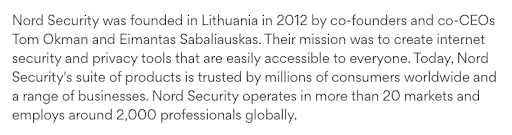
NordVPN, meanwhile, presents itself as a product of Nord Security, a global cybersecurity company founded in Lithuania in 2012 by Tom Okman and Eimantas Sabaliauskas. The company also develops products like NordLayer, NordPass, NordLocker, NordLynx, NordStellar, Saily, and NordProtect.
What NordVPN actually offers is a VPN, essentially an invisible layer for your online activity. If you've ever heard someone in Spain say they're watching the U.S. Netflix catalog, or streaming a tennis match on ESPN+ that’s blocked in their region, they’re probably using a VPN.
Contrary to what many would assume, the relationship between Cybernews and NordVPN is not completely hidden information. But yes, you do have to dig a little to find it.
Buried in its Terms and Conditions, Cybernews states that it belongs to Mediatech, a publishing company whose investors include the founders of Nord Security, the company behind NordVPN and Surfshark, among other products that Cybernews itself reviews and ranks.
If we flip that around, the picture becomes easier to understand: the founders of Nord Security, NordVPN’s parent company, appear as investors in Mediatech, the publishing group that owns Cybernews.
With that on the table, at least a couple of interpretations emerge. On one hand, it could simply be another investment inside a large business structure. On the other, the fact that this disclosure is tucked away in the Terms and Conditions, rather than somewhere more visible like an About Us page, could be interpreted as a sign that it isn’t considered particularly important for readers.
Formally, the information is there. But where it is placed raises questions about how accessible or clear it really is for someone visiting the site looking for independent guidance.
In the same section, Cybernews emphasizes that its research and analysis are conducted independently. Still, when ownership connections like these exist, it’s reasonable for readers to wonder whether they could influence, directly or indirectly, which products are recommended and which are left out.
Ultimately, the issue is not just whether the relationship is disclosed, but how and where it is communicated. Transparency is not simply about information existing somewhere. It’s about readers being able to find it and understand its significance without needing a magnifying glass. And that’s where a large part of any publication’s credibility is tested.
If we dig a little deeper, we run into what seems to be the heart of the whole story: Tesonet.
Tesonet is the technology incubator created by Tom Okman and Eimantas Sabaliauskas, and it is where Nord Security itself was born. The founders confirmed this in a 2023 interview with Bloomberg. And this is where another piece of evidence appears.
In that same Bloomberg article, a Nord spokesperson acknowledged that Tesonet had worked for years with Cybernews owner Adtech LT UAB, and had even invested in a new parent company connected to the site.
Now things seem to move beyond an investment in the publishing company that owns Cybernews. We’re talking about years of collaboration between the incubator founded by NordVPN’s owners and Cybernews’ ownership structure. There is a difference between those two things, isn’t there?
A Reddit user, who like me had also looked into this, claimed they reviewed the profiles of Cybernews employees and noticed that several had previously worked at Tesonet until around 2020.
And while that sounds like compelling evidence, when I checked myself I found that this only clearly applied to Aras Nazarovas, a Security Researcher at Cybernews who had previously worked as a Customer Success Manager at Tesonet.
I have to admit, considering the role he now holds, it does stand out. That said, it’s also impossible to completely rule out that other profiles were modified or removed after that Reddit thread was published four years ago.
In the same Bloomberg article, Cybernews editor-in-chief Jurgita Lapienyte stated that her team "adheres to the fundamental principles of journalism" and that its analysis is "not influenced in any way by the company’s business goals."
But again, saying something and seeing it play out in practice are two very different things. And it feels a little... and by little I mean very... obvious that reality might not be so simple.
That’s because Cybernews consistently ranks NordVPN and Surfshark, both also part of the broader Tesonet ecosystem, as top choices across the vast majority of its rankings.
They do it in their article on the best VPNs of 2026.
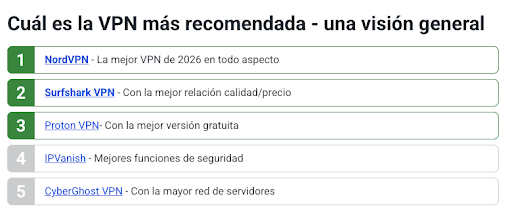
They do it in rankings of the easiest VPN services to use.
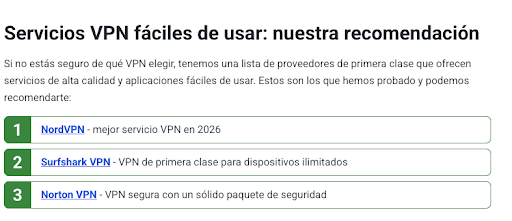
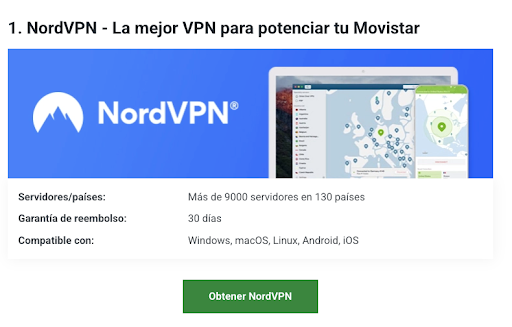
They do it in guides about the best VPN for improving your Movistar connection.
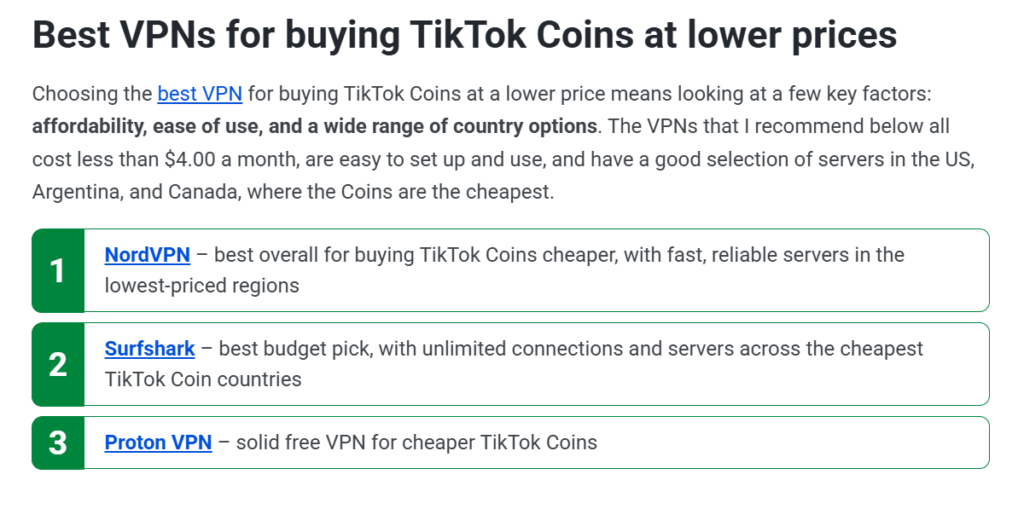
And if you’re wondering which VPN is best for finding cheap flights or buying TikTok Coins at a lower cost, surprise: NordVPN also comes out on top there.
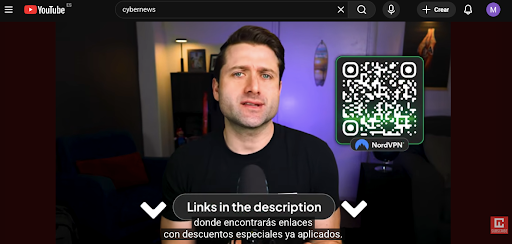
I also checked their YouTube channel and found much of the same pattern: NordVPN and Surfshark win reviews, and affiliate links are placed directly in the video descriptions.
Cybernews openly acknowledges in its Terms and Conditions that some of its links are affiliate links and can generate compensation, but this goes beyond affiliate links alone.
We’re looking at rankings, reviews, and videos where the same companies consistently appear first. And once you know about the relationship behind the scenes, it becomes difficult not to look at the information with a degree of skepticism.
And to be clear, this is not to say NordVPN is a bad product. In many cases, it may absolutely outperform competitors.
But as users, we often end up making purchasing decisions blindfolded.
It’s incredibly difficult for us to know which VPN can truly be trusted with our security. We can’t walk into their data centers ourselves and verify security practices or confirm that traffic logs aren’t being stored.
What we can do, and what we usually do, is trust the people who are supposedly watching all of this on our behalf.
But how do we do that if the watchdog works for the guard?

The best global eSIM provider
From $2.3/week
A reliable eSIM provider for budget travelers
From $2.4/week
The best global eSIM provider
From $2.3/week
A reliable eSIM provider for budget travelers
From $2.4/week
Our mission is simple: to make sure you never have to ask, “What’s the WiFi password?” again. All our tips come straight from personal experience — because we’d never recommend something we haven’t put to the test ourselves.
Reviews