

Florence is one of Italy’s most visited cities, where Renaissance art, historic piazzas, and Tusca...


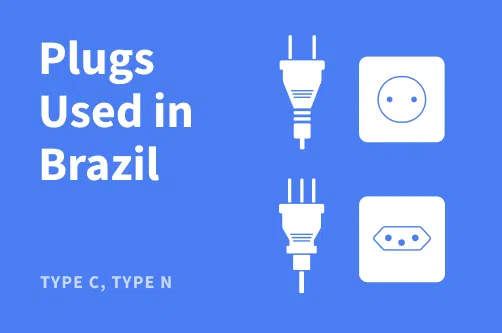
In Brazil, wall outlets are Type C and Type N. Any plug that is not one of these types will need an adapter to fit. A voltage converter is only necessary if your device is not dual voltage; check the label for ‘Input: 100–240V’ to confirm.
Brazil has two standard plug types: Type C, a slim plug with two round prongs, and Type N, a slightly bulkier plug with three round prongs forming a triangle.
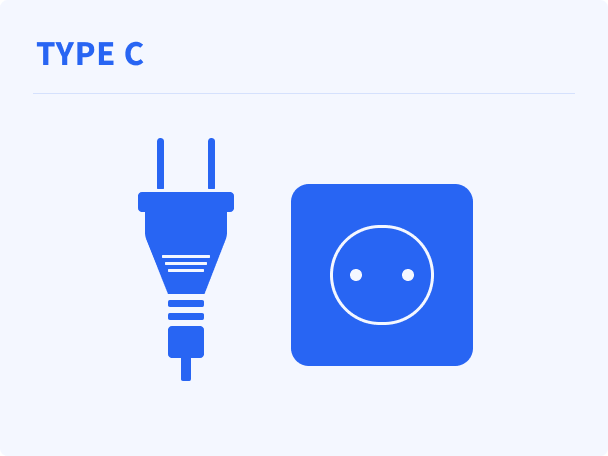
Plug Type C has two round pins of equal size. This is the same plug shape commonly used across much of Europe. It is compact and ungrounded, with no third pin. Many hotels, apartments, and older buildings in Brazil still have Type C outlets, so travelers often see this plug style first.
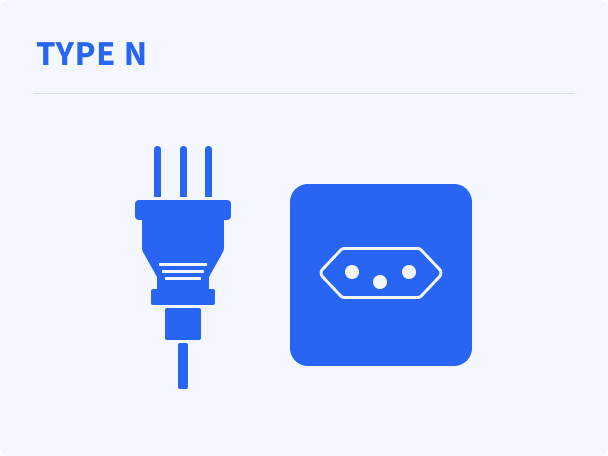
Plug Type N has three round pins arranged in a triangular pattern, with the grounding pin at the bottom. It’s Brazil’s official standard plug and is designed to be safer and more stable than older plug types. Newer buildings and recently renovated properties are more likely to have Type N outlets.
You can easily find Brazil-compatible plug adapters online before your trip or at major retailers. Look for adapters that support Type C and Type N outlets.
This compact adapter is designed specifically for Brazil’s Type N outlets and supports both 2-prong and 3-prong North American plugs. It features two grounded outlets, supports devices up to 10A and 250V, and is suitable for phones, laptops, cameras, and chargers. It works only with dual-voltage devices and doesn’t function as a voltage converter.
Price: Around $14 USD
This multi-device adapter is designed for Brazil’s Type C and Type N outlets and accepts U.S. Type A and B plugs. It includes two U.S. sockets, one USB-A port, and one USB-C port, allowing you to charge up to four devices at once. It works with dual-voltage devices only and doesn’t convert voltage.
Price: $19.99 USD
This multi-port adapter features a Type C plug and is designed for many European countries. It converts one Type C outlet into four U.S. AC sockets and four USB ports, allowing you to charge up to eight devices at once. The foldable, cord-free design makes it compact and cruise-ship approved. It’s rated up to 10A and 250V and works with dual-voltage devices only.
Important: This adapter supports Type C outlets only and doesn’t support Brazil’s Type N sockets, so it may not work in locations that use Type N outlets. It doesn’t convert voltage.
Price: $46.99 USD
This Type N travel adapter is designed specifically for Brazilian outlets and accepts U.S. plugs. It features four American AC outlets, one USB-C port, and two USB-A ports, allowing you to charge up to seven devices at once. The compact, four-sided design prevents bulky chargers from blocking other ports, and it has no surge protection, making it suitable for cruise travel. It’s intended for dual-voltage devices only and does not convert voltage.
Price: $23.39 USD
This Type N travel adapter is designed specifically for Brazilian outlets and accepts U.S. plugs. It converts one Brazilian socket into two American outlets, three USB-A ports, and one USB-C port, allowing you to charge up to six devices at once. This adapter is for dual-voltage devices only and doesn’t convert voltage.
Price: $15.99 USD
Most travelers don’t need a voltage converter in Brazil, but problems usually come up with appliances rather than phones or laptops.
Brazil operates on 127V or 220V, depending on the area. Devices such as phones, laptops, and chargers typically support 100–240V, so they work with just a plug adapter.
You’ll need a voltage converter if your device is single-voltage or 110–120V only. This commonly applies to hair dryers, electric shavers, and small appliances. Using these in a 220V outlet without a converter can damage the device.
There are typically four ways to get internet in Brazil: roaming, eSIMs, local SIM cards, and pocket WiFi.
Roaming lets your phone connect to Brazilian networks such as Vivo, Claro, and TIM using your home carrier. For example, AT&T roaming International Day Pass costs $12 per day in Brazil, and Verizon roaming TravelPass is also $12 per day, making it convenient but expensive for longer trips.
eSIMs are digital SIMs you install on your phone, offering instant activation, no physical SIM, and no documents required, which is useful since SIM registration in Brazil can be strict. Holafly is best for unlimited data with only $7.90 per day, while Maya is a strong alternative for travelers who want flexible data packages across Brazil.
A local SIM card from Brazilian carriers like Vivo, Claro, or TIM provides direct access to local networks at lower rates than roaming. However, in Brazil this often requires passport registration, possible CPF verification, and in-store activation, which can be inconvenient for short stays.
Pocket WiFi is a portable hotspot that connects to Brazilian mobile networks and shares internet with multiple devices. A popular option is MioWiFi, which rents devices for around $8 per day, making it practical for groups or travelers with multiple devices, though you must carry, charge, and return the unit.
Brazil’s Type C and Type N outlets are only one part of a much wider global system.
Around the world, countries use different pin shapes, grounding methods, and layouts, which is why the same charger can work in one destination and not in another.
The infographic below shows the major plug types used internationally and how they differ.
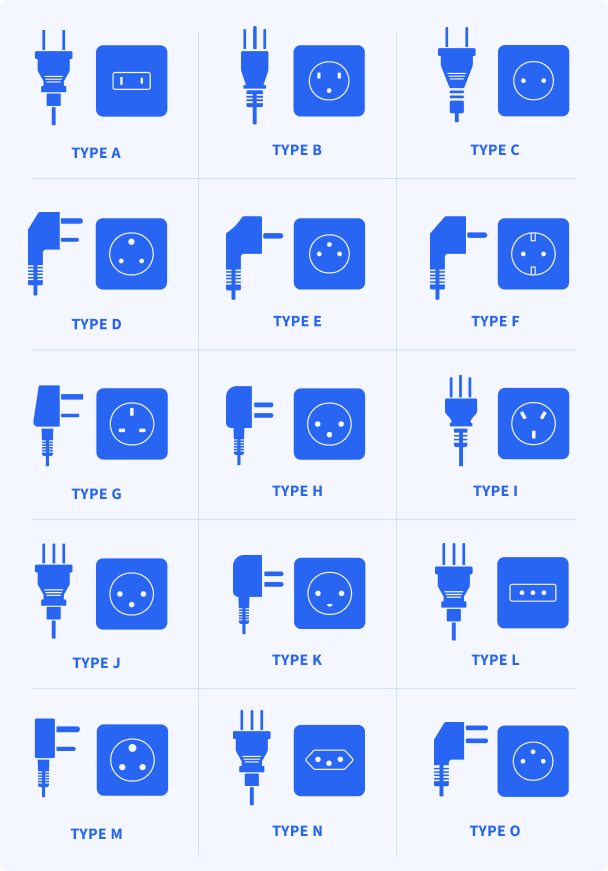
Knowing how these plug systems differ makes it easier to choose the right adapter for each destination and avoid charging issues while traveling.
| Plug Type | Countries That Use This Plug |
| Type A / Type B | United States, Canada, Japan, Colombia, Taiwan |
| Type C / Type E | France, Belgium |
| Type G | United Kingdom, Ireland, Kenya |
| Type A / Type C / Type I | China |
| Type C / Type H / Type M | Israel |
| Type C / Type D / Type M / Type N | South Africa |
| Type C / Type F | Germany, South Korea, Iceland, Finland, Norway, Sweden, Greece, Spain, Netherlands, Indonesia |
| Type I | Australia, New Zealand |
You need a plug adapter for Type C or Type N outlets when traveling to Brazil. If your devices use U.S., Canadian, or UK plug types, they will not fit Brazilian sockets without an adapter.
Brazil shares Type C with much of Europe, so some European plugs may fit certain outlets. However, Brazil also uses Type N, which is different from most European plugs and may still require an adapter.
Brazil uses Type C plugs with two round pins and Type N plugs with three round pins arranged in a triangle. Type N has a grounding pin and is more common in newer buildings.
No, Brazil does not use the same plugs as the United States. U.S. Type A and B plugs will not fit Brazilian outlets without an adapter.
No, Brazil doesn’t use the same plugs as the United Kingdom. UK Type G plugs require an adapter to work in Brazil.
No, Brazil doesn’t use the same plugs as Canada. Canadian Type A and B plugs need an adapter for Brazilian outlets.

The best global eSIM provider
From $2.3/week
A reliable eSIM provider for budget travelers
From $2.4/week
The best global eSIM provider
From $2.3/week
A reliable eSIM provider for budget travelers
From $2.4/week


Our mission is simple: to make sure you never have to ask, “What’s the WiFi password?” again. All our tips come straight from personal experience — because we’d never recommend something we haven’t put to the test ourselves.
Reviews