


SIM Cards
Vivo stands out as the best SIM card in Brazil for coverage and value, but for short solo trips, in my experience, an eSIM like Holafly is often the more practical choice thanks to its quick setup and convenience.


Choosing the right SIM card in Brazil depends on how you plan to use your phone, so I looked at options by price, data, validity, and network coverage, as well as where it’s easiest to get one, whether at the airport or in city stores. I focused on prepaid SIMs that work well for travelers, covering basics like maps, messaging, and quick browsing.
Quick pick: the best SIM card for Brazil is Vivo because it offers reliable nationwide coverage and plans that are easy to buy and set up. Local SIMs are usually cheaper than eSIMs, but you’ll need a passport, a store visit, and a few extra minutes to get online.
Note *All pricing information in this article is accurate as of March 12, 2026. Prices are subject to change at any time, so we recommend checking directly with each SIM and eSIM provider for the most up-to-date details before making a purchase.*
Quick verdict: For most travelers, a Vivo tourist SIM is the easiest way to stay connected in Brazil. You buy the SIM, then choose a data package that fits your needs, such as a bundle with 25 GB of data for maps, messaging, and browsing.
If you prefer a smaller prepaid option for short trips, TIM Brasil’s visitor SIM (R$25 / $4.80 for 1.5 GB / 7 days) is ideal for light data use. For a flexible digital option, Inter’s standard prepaid plan (R$17 / $3.26 for 6 GB / 15 days) works well for travelers comfortable managing setup via their app.
| Provider | Price (from) | Data | Validity | Network coverage in Brazil | Where to buy | Best for |
| Vivo | R$55 ($ 10.55) | 25GB + 300 minutes + 100 SMS | 30 days | Strong nationwide coverage including rural areas | Vivo stores, selected retailers | Travelers needing lots of data for navigation, streaming, and social media, or longer trips across Brazil |
| TIM Brasil | R$25 ($ 4.80) | 1.5GB | 7 days | Good coverage in cities & tourist areas | TIM stores, some airport kiosks | Short trips, light data use for maps and messaging, easy airport pickup for convenience |
| Inter | R$17 ($ 3.26) | 6 GB | 15 days | Uses Vivo’s network, reliable coverage | Online/app only | Budget-conscious travelers comfortable setting up a digital plan via the app, moderate data use for messaging and browsing |
Airport convenience: TIM Brasil has kiosks and stores at major airports, making it easy to get online immediately. Vivo SIMs are primarily sold in city stores, and Inter’s plan is fully digital via its app.
Best value: Inter’s prepaid plan gives a decent data bundle at a low price, perfect for budget-conscious travelers.
Longer stays or heavy data: Vivo’s tourist SIM provides the most data and reliable coverage across Brazil.
Short trips, hassle-free: TIM’s visitor SIM allows quick setup and enough data for light browsing without hunting for a store.
Brazil has several strong local mobile options for travelers, but three stand out for prepaid SIM cards that are easiest to use while visiting: Vivo, TIM Brasil, and Inter. These carriers provide reliable coverage across cities and many popular tourist areas, good data options, and multiple ways to purchase, including airport kiosks, retail stores, or online.
Data bundles and pricing can change often, so travelers should always check the latest details in-store or on the official carrier websites before buying.
Vivo is one of Brazil’s largest mobile carriers with extensive nationwide coverage. Their tourist SIM is designed for travelers, offering reliable service in both cities and many rural areas. It’s ideal for those who need plenty of data for navigation, streaming, or social media during longer trips.
The carrier is widely present across the country, with numerous stores and authorized retailers. Travelers can also buy SIMs online for convenience. Vivo is best for tourists looking for a balance of strong coverage, generous data, and minimal setup hassle.
| Duration | Data | Pricing | Notes |
| 30 days | 25GB | R$55 ($ 10.55) | Includes access to social apps; data only; good for heavy use |
Quick verdict: Vivo’s tourist SIM is best for travelers needing large data bundles and strong nationwide coverage. The main trade-off is a slightly higher price, but it’s available in Vivo stores and selected retailers for easy purchase.
TIM Brasil is one of the major mobile carriers in Brazil. They offer a tourist-friendly prepaid SIM designed for international visitors. The international visitors plan gives travelers a simple way to stay connected. It includes a basic data bundle and flexible recharge options. TIM has good coverage in cities and reliable service in popular tourist areas.
The carrier’s international visitors SIM is widely available in TIM stores and some airport kiosks. Activation requires a passport and temporary address, and additional credit top‑ups are easy to find at local banks, pharmacies, and convenience stores. TIM is best for budget‑minded travelers who need essential data without a long‑term commitment.
| Duration | Data | Pricing | Notes |
| 7 days | 1.5GB | R$25 ($ 4.80) | Tourist‑friendly bundle for basic data use |
Quick verdict: TIM Brasil’s visitor SIM is perfect for travelers on short trips who want affordable data for navigation and messaging. The trade‑off is a smaller data allowance, but you can buy it easily at TIM stores or some airport kiosks before exploring the city.
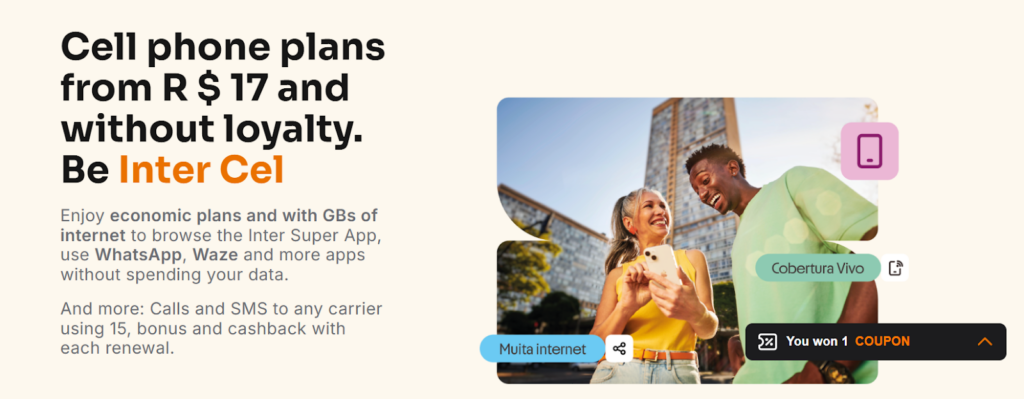
Inter Cel is the mobile arm of Banco Inter, offering simple prepaid plans you control entirely through the Inter app. The service uses the Vivo network, giving wide coverage across Brazil without contracts or long-term commitments. It’s a good pick for travelers who want flexibility and manage everything from their phone.
Plans are fully digital, so you don’t need to visit a store to buy or activate a SIM. With options ranging from smaller to larger data bundles, Inter Cel works well for moderate data use and app‑based setup without paperwork.
| Duration | Data | Pricing | Notes |
| 15 days | 6 GB | R$17 ($ 3.26) | Basic bundle via app |
| 30 days | 20 GB | R$30 ($ 5.76) | Mid‑range data option |
| 30 days | 25 GB | R$45 ($ 8.63) | Larger data bundle |
| 30 days | 30 GB | R$55 ($ 10.55) | Biggest prepaid option |
Quick verdict: Inter Cel’s plans are best for travelers comfortable with a digital‑only SIM and mobile app setup, offering solid data at low prices. The trade‑off is no physical store purchase, so you’ll need to manage everything online via the app.
During my trip, I tried relying entirely on local SIM cards, and while it worked fine, setup usually took more time than expected. Finding the right store, waiting for staff to activate the SIM, and ensuring the plan loaded correctly added a noticeable delay to my first day.
Here’s a breakdown of your main options:
Important tip: Make sure the SIM is fully activated before leaving the store or kiosk. Test that data works and apps are accessible. Activation usually takes a few minutes, but it is worth checking on-site to avoid surprises later.
Finding and registering a local SIM in Brazil can take time, especially on a short trip. During my travels, I tested several eSIM options instead. In my experience, they were much easier to set up. You can buy them online, scan a QR code, and get connected within minutes without visiting a store.
Because of that, eSIMs often make more sense for travelers who want a quick and simple setup. I’ve used some of the providers below on different trips, and they worked reliably for Google Maps and browsing without the extra steps that local SIM cards usually require.
| Provider | Best for | Notes |
| Holafly | Travelers who need unlimited data | Great if you want unlimited data without worrying about usage limits. Setup is fast and simple, and it works right after installation. |
| Airalo | Budget travelers needing fixed data | Good option for smaller prepaid data packages. Easy to install and suitable for messaging, navigation, and light browsing. |
| Maya Mobile | Flexible short-term data plans | Offers several data bundles and validity options. Good if you want flexibility without committing to an unlimited plan. |
Quick take: Holafly is best if you want unlimited data without worrying about limits, Airalo is great for cheaper fixed data bundles, and Maya Mobile works well if you want flexible data.
For most travelers, Vivo is often considered the best SIM card in Brazil because of its strong nationwide coverage and generous data bundles. It works well in major cities and many rural areas, making it a reliable choice for tourists who plan to travel around the country.
It depends on your priorities. A local SIM card is usually cheaper, but it can take time to buy and activate because registration is required. An eSIM is often easier for short trips since you can install it online before arrival and get connected immediately.
Yes. Foreign travelers can buy prepaid SIM cards from major carriers such as Vivo or TIM. In most cases, you will need to show your passport so the provider can register the SIM before activation.
Vivo is widely known for having one of the strongest networks in Brazil, especially outside major cities. TIM also offers solid coverage in urban areas and tourist destinations.
Many travelers use providers like Holafly, Airalo, or Maya Mobile. Holafly is popular for unlimited data plans, while Airalo and Maya Mobile offer flexible fixed data bundles that can be installed before you arrive.
Vivo offers the best coverage in Brazil, reaching major cities, highways, rural areas, and smaller towns. Its network is reliable for navigation, messaging, and streaming, making it the top choice for travelers who want consistent connectivity across the country.
Yes. You can usually find SIM cards from providers like TIM or Vivo at kiosks or stores in major airports such as São Paulo–Guarulhos International Airport. Availability can vary, so some travelers prefer buying a SIM in the city or using an eSIM before arrival.
No. WhatsApp is not blocked in Brazil and is one of the most widely used messaging apps in the country. Many locals rely on it for communication, and mobile plans often include special data allowances for WhatsApp messaging and calls.

Our mission is simple: to make sure you never have to ask, “What’s the WiFi password?” again. All our tips come straight from personal experience — because we’d never recommend something we haven’t put to the test ourselves.
Reviews