


Mobile Internet
Travelers in Italy typically choose between roaming, local SIM cards, pocket WiFi, or eSIMs, each with its own trade-offs. For most trips in 2026, eSIMs stand out as the best overall choice, offering a balance of convenience, reliable coverage

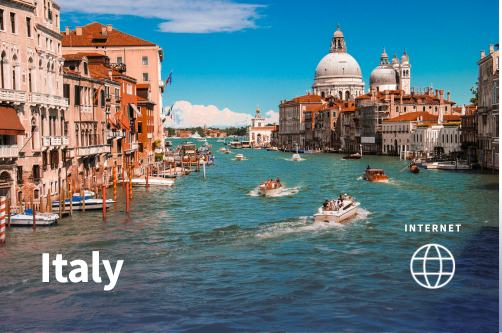
Getting online in Italy is pretty straightforward, but choosing the right setup before your trip can make a big difference.
The good news is that Italy has solid mobile coverage, especially in cities and popular travel areas. Speeds are generally fast, and for most travelers, using maps, messaging, or even working online won’t be an issue.
Where people usually get stuck is choosing how to connect. In most cases, it comes down to four main options: roaming, a local SIM card, a pocket WiFi device, or an eSIM.
Here’s what you actually need to know before you go.
If you look at all the options side by side, a few things become pretty clear:
For most trips in 2026, an eSIM is usually the simplest choice.
In my experience, it’s also the most convenient option. I’ve used eSIMs on several trips, including in Italy, and it’s a relief to have everything working as soon as I land after a long flight.
You can set it up before you arrive, there’s no need to visit a store, and you don’t have to remove your current SIM card.
It just works as soon as you land, which is exactly what most travelers want.
Once you’ve got a general idea of what works best, the next step is choosing the option that actually fits your trip.
Your main options are:
Let’s go through them one by one.
An eSIM is built into your phone, so instead of inserting a physical card, you install a plan digitally, usually by scanning a QR code.
Once it’s set up, your phone connects automatically to local networks in Italy.
Coverage is very reliable across the country. You’ll have 4G in most places where people live or travel, and 5G is widely available in cities like Rome, Milan, and Florence.
For everyday use, it’s more than enough for things like Google Maps, social media, video calls, and even remote work if needed.
I’ve used eSIMs in Italy on multiple trips, and it’s easily the most convenient option. After a long flight, the last thing I want is to search for a SIM card shop.
Having data working right away makes getting from the airport to my accommodation much easier.
Still, there are a couple of small things to keep in mind:
If you’re not sure which provider or plan to choose, check out our guide to the best eSIMs for Italy.
Tip: Make sure your phone supports eSIM and is unlocked before buying a plan.
Verdict: If you want something simple that works right away, this is usually your best bet.
If you’re staying longer or want a local number, getting a SIM card in Italy can be a good option.
The main providers are TIM, Vodafone Italy, and WindTre, and they all offer prepaid plans with plenty of data for a reasonable price.
The downside is the setup. You’ll usually need to:
You can buy SIM cards at airports, official carrier shops, electronics stores, and sometimes even kiosks or convenience shops.
The process itself is straightforward, but it does take more time and effort compared to using an eSIM.
Verdict: solid choice for longer stays or if you need a local number, but it requires more time to set up than other options.
Roaming is what a lot of people still default to because it requires zero setup. You land, turn your phone on, and it just connects.
The catch is the price.
If you’re traveling from outside the EU, especially from the U.S. or Canada, roaming charges can add up fast. Most plans either charge per day or per MB, and neither is usually cheap.
If you’re coming from another EU country, though, you’re in luck. Thanks to EU rules, you can usually use your plan in Italy at no extra cost.
Before your trip, it’s worth:
Verdict: Fine for very short trips or emergencies, but too expensive for most travelers.
Pocket WiFi devices are small routers you carry around that give internet access to multiple devices at once.
They’re often marketed as a great solution for groups, and in some cases, they are.
But in reality, they come with a few annoyances:
They’re also not cheap, especially compared to eSIM plans.
Since most phones can already share data via hotspot, many people end up skipping this option entirely.
Best for: Families or groups who want to connect several devices at once.
See also: What plug types are used in Italy?
You’ll find free WiFi all over Italy: hotels, cafés, airports, and even some public spaces. It’s handy, but not something you should depend on.
Speeds can be inconsistent, connections may drop, and open networks aren’t always secure.
Public WiFi is fine for checking emails or doing quick searches, but for anything important, mobile data is more reliable.
Tip: Avoid logging into sensitive accounts on public WiFi, or use a VPN.
Verdict: Useful as a backup for light use, but not reliable or secure enough to rely on as your main connection.
Prices vary depending on what you choose, but here’s a rough idea for a week:
| Option | Typical cost per week |
| eSIM | $8–$25 |
| Local SIM | $5–$15 |
| Pocket WiFi | $50–$80 |
| Roaming | $50–$120+ |
When you factor in convenience and setup time, eSIMs usually come out on top for short trips.
How much data you need in Italy really depends on how you typically use your phone, tablet, or laptop:
Tip: To use less data, download maps ahead of time and rely on hotel WiFi for updates. It also helps to avoid streaming in high quality when using mobile data.
For most travelers, an eSIM is the simplest option. It can be set up before arrival and works as soon as you land in Italy.
Yes, coverage is generally very good throughout Italy, especially in cities and popular tourist areas. You’ll usually have 4G almost everywhere, with 5G available in larger cities.
Yes. If you have a mobile plan from an EU country, you can typically use your data, calls, and texts in Italy without paying extra.
Yes, in most cases, you’ll need to show your passport when purchasing a SIM card in Italy due to registration requirements.
If your phone supports dual SIM, you can use both at the same time.
Is roaming expensive for travelers visiting Italy from outside the EU?
Yes, roaming in Italy can be quite expensive for travelers coming from countries like the United States or Canada, depending on your provider.
Most eSIM and local SIM plans in Italy allow hotspot use, although limits can vary depending on the provider and plan.
For most solo travelers, pocket WiFi isn’t necessary in Italy. It can still be useful for families or groups who want to connect multiple devices at the same time.

Our mission is simple: to make sure you never have to ask, “What’s the WiFi password?” again. All our tips come straight from personal experience — because we’d never recommend something we haven’t put to the test ourselves.
Reviews