

Reviews
I tested Airhub’s eSIM across Bosnia to see if a $9 plan could actually handle real travel. I used it for Google Maps on long drives, WhatsApp messaging, speed tests, and YouTube in cafés, including a few moments where the connection dropped outside the cities. Here’s my honest experience.

I didn’t choose Airhub because of the brand. I chose it because the price looked almost suspiciously cheap ($9 for 7 GB) in Bosnia, and I wanted to see if it could actually handle a real trip.
So I bought the plan, installed it on my Samsung, and used it the way you actually use mobile data when traveling: Google Maps for long drives between cities, WhatsApp for meeting up with people, speed tests along the way, and the occasional YouTube video in cafés.
This isn’t a specs breakdown or a rewritten product page. It’s the real experience after a week on the road across Bosnia and Herzegovina: where it worked great, where it didn’t, and whether the low price is actually worth it.
The Verdict: Airhub delivers genuinely affordable data on a reliable local network in Bosnia, and the pricing is hard to beat. However, widespread negative online reviews suggest the experience can be inconsistent, and information on the website doesn’t always match what customer support provides.
Score: 3.4 / 5

Airhub offers several Bosnia-specific plans, all running on BH Telecom's 4G network. What immediately stood out is the price-per-GB ratio.
Compared to competitors like Airalo and Maya Mobile, Airhub consistently undercuts on price. They also offer a free 200 MB eSIM for three days, which is a smart way to test coverage before committing money.
For my trip, I was spending about a week between Banja Luka and Sarajevo, with a mix of navigation, messaging, and light streaming. The 7 GB / 30-day plan at $9.00 seemed like the best fit, enough data for daily use without overpaying for a larger bucket I would not exhaust.
Here is how Airhub's Bosnia plans break down:
| Data | Validity | Price (USD) |
| 1GB | 7 days | $2.50 |
| 4GB | 30 days | $6.00 |
| 7GB | 30 days | $9.00 |
| 12GB | 30 days | $15.50 |
| 20GB | 30 days | $23.00 |
Verdict: For a week-long trip to Bosnia, the 7 GB plan at $9 is a steal. If you are a heavier user or want to make local calls, the 20 GB plan at $23 is solid value. The free 200 MB trial is a genuine differentiator, you can use it to verify coverage before spending a cent.
★★★★ 4/5
I purchased the Bosnia 7 GB / 30-day plan ($9.00) through the Airhub website two days before my flight. I chose the website over the app deliberately because multiple reviews warned that the app is buggy, and a lot of people explicitly recommend avoiding it. That turned out to be good advice.
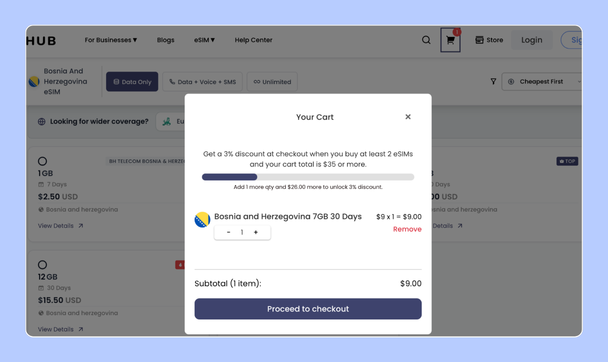
I expected the QR code to arrive instantly, and in my case, it did. The email with the QR code and installation instructions arrived almost immediately.
I was actually relieved to see this, because one of the most common complaints online is delayed delivery. Many users report waiting much longer, sometimes hours, or even needing to contact support.
Because I had read so many of these stories, I purchased the eSIM two days in advance just to be safe. Even though my experience was smooth, ordering ahead of time still felt like the right decision, especially if you might be relying on it at the airport or right before departure.
Once the email arrived, setup was clean:
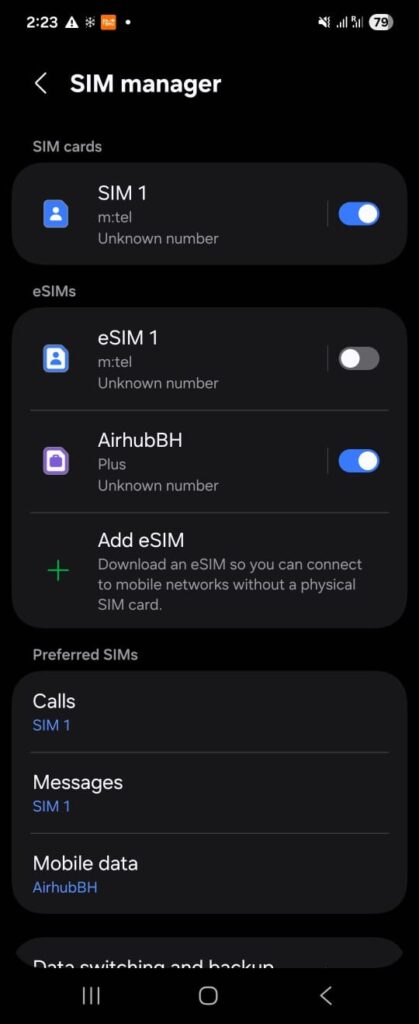
After landing in Bosnia, I toggled Data Roaming on, and the eSIM connected to BH Telecom within about 90 seconds. There was no need to select a manual network, it locked on automatically. I had a working data connection before I even cleared passport control.
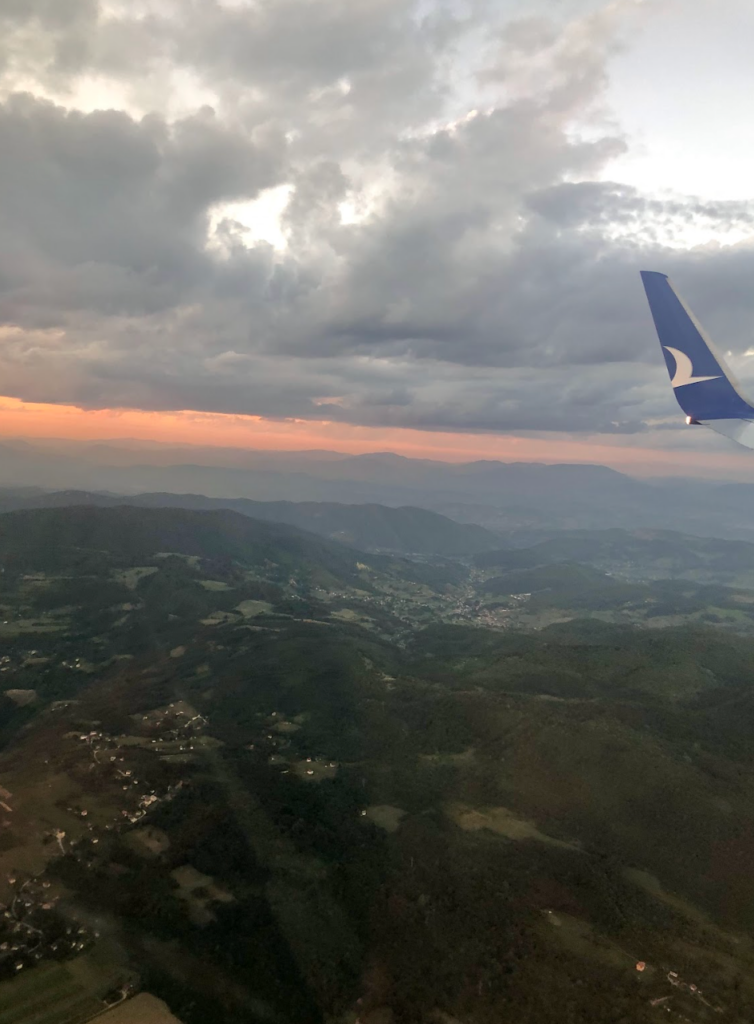
Verdict: Setup through the website was smooth and straightforward. The QR code arrived almost immediately, and installation took about three minutes with no issues. That said, ordering the eSIM a day or two in advance is still a smart precaution.
★★★★ 4/5
I used the Airhub eSIM for seven days across Bosnia and Herzegovina, primarily in Banja Luka and Sarajevo, with some driving through smaller towns in between. Daily usage included Google Maps, WhatsApp messaging and voice notes, web browsing, and occasional YouTube streaming.
In the cities, the eSIM performed well. BH Telecom's 4G network is solid in urban areas, and I rarely dropped below three bars. Outside the cities, in the less populated corridors between Banja Luka and Sarajevo, signal would occasionally dip to 3G or drop briefly, but it always recovered within a minute or two.
Let me be upfront: this was not a flawless experience. I had one 10-minute stretch on the highway near Doboj where data dropped entirely. It came back on its own, but if I had been relying on turn-by-turn navigation at that exact moment, I would have been frustrated.
Before sharing numbers, here is exactly how I ran each test to keep things consistent:
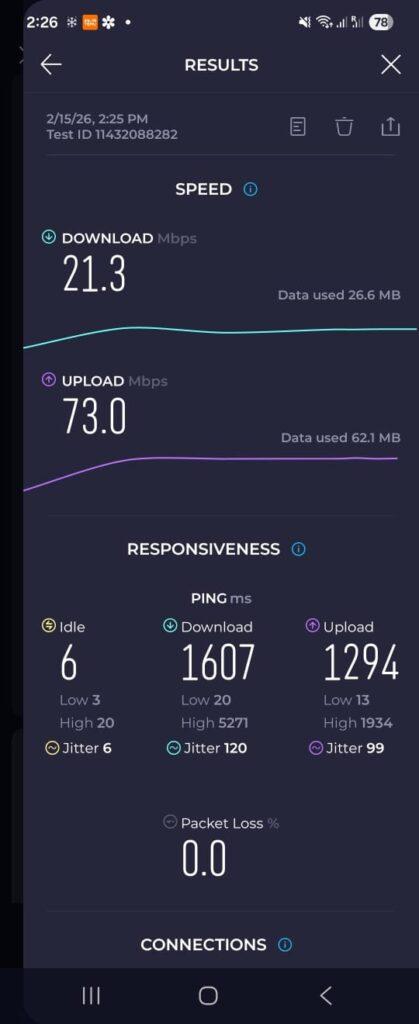
In real terms, 21–31 Mbps download is more than enough for anything a traveler needs. Maps load instantly, photos send in seconds, and even 720p video plays without buffering.
The Doboj highway dip was the only time speeds felt noticeably sluggish. Pages loaded slowly and a Google Maps reroute took about 8 seconds instead of the usual 1–2 seconds.
I used Google Maps for daily navigation throughout the trip, driving from Banja Luka to Sarajevo (roughly 3 hours), getting around the side streets in both cities, and finding restaurants and landmarks.
The real test came on the drive to Sarajevo. About 40 minutes in, I intentionally missed a highway exit to force a reroute. Google Maps recalculated within 2 seconds and offered an alternative route immediately.
The map tiles stayed loaded, the blue navigation arrow tracked smoothly, and I never lost the route overlay. In Sarajevo's narrow old town streets, where GPS can sometimes bounce between buildings, the eSIM held a stable connection and Maps stayed responsive.
The only hiccup was the Doboj dead zone I mentioned earlier (for about 10 minutes), Maps was running on cached tiles. It never fully lost the route, but the live traffic overlay disappeared and I could not have searched for a new destination during that stretch.
WhatsApp is the default communication tool for most travelers, so I tested the three main use cases:
I never had any issues with messages. Everything was sent right away, every time. It was really convenient for meeting up with people, dropping my location, or checking in with family.
This is not a home-broadband streaming test. I tested the way most travelers actually watch video: a quick YouTube clip at a coffee shop, not a two-hour Netflix movie on cellular data.
I played a 7-minute YouTube video at 720p in a Sarajevo café. Startup was nearly instant: the video began playing within 2 seconds of tapping. There was zero buffering throughout playback, and the quality held at 720p without dropping.
I tried the same test later in Banja Luka and got similar results. On the drive between the cities, there were a few stretches with weaker (3G-level) signal. I checked it during a coffee stop along the way - a short YouTube clip took a bit longer to start and played at a lower quality (around 480p).
Across seven days and two cities, the Airhub eSIM on BH Telecom delivered consistent, reliable connectivity for everything a traveler actually needs:
The core takeaway: consistency matters more than peak speed. I never hit 100 Mbps, but I was always able to do what I needed. The eSIM just worked the whole trip, which is exactly what you want when you’re traveling.
Verdict: Airhub's real-world performance in Bosnia is solid. 4G network covers the cities well, and speeds are more than adequate for navigation, messaging, and light streaming. The occasional rural dead zone is a network limitation, not an Airhub failure.
★★★★ 4/5
I tested hotspot tethering by connecting my MacBook Air to the iPhone's personal hotspot running on the Airhub eSIM. This was a practical test, I had a few hours of remote work to get through and wanted to see if the eSIM could handle it.
I would not recommend tethering for video calls or downloading large files. The upload speeds (7–11 Mbps) are fine for text-based work but might struggle with HD video conferencing. For catching up on emails, editing documents, and light browsing, the hotspot works well.
Verdict: Hotspot is supported on Airhub's Bosnia plans and works reliably for basic remote work tasks. Stable enough for email, documents, and messaging; not ideal for video calls or heavy uploads.
★★★ 3/5
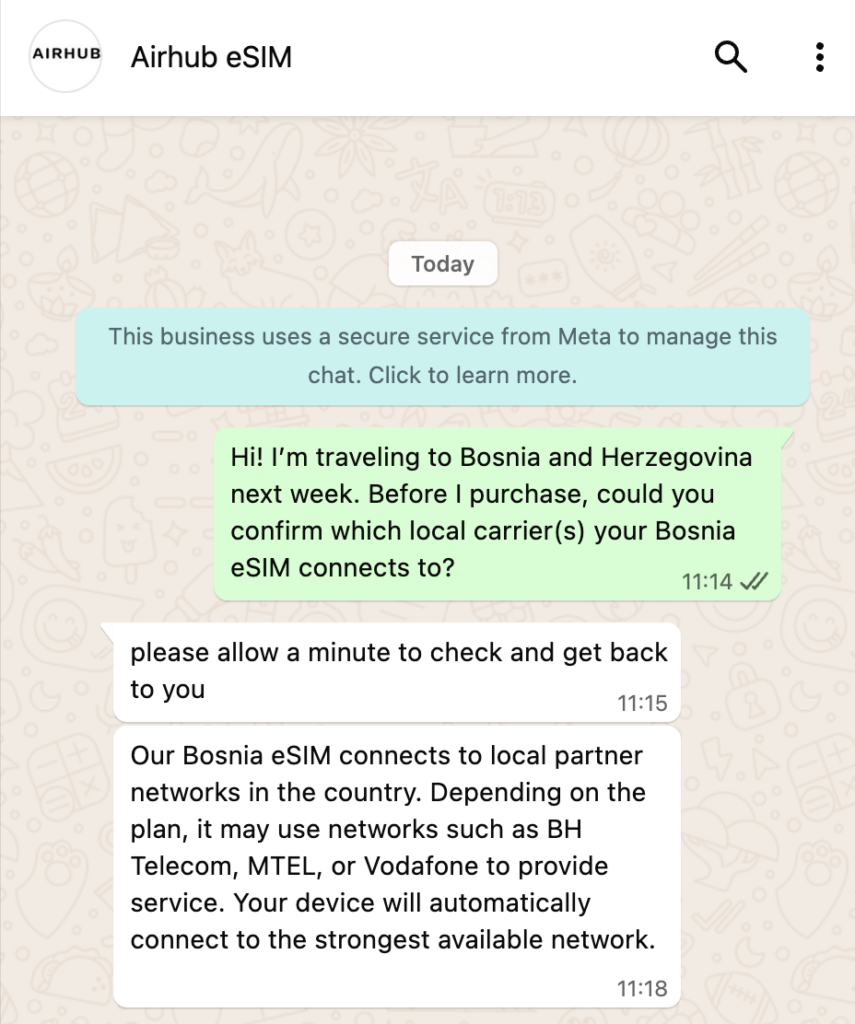
Airhub promotes customer support primarily through email and a separate escalations email, but in practice I was also able to reach them quickly through messaging channels. From their site interface, I accessed a Whatsapp contact option and used it to run a test before traveling.
For this test, I asked a simple pre-purchase question: which local networks their Bosnia eSIM connects to. The response arrived within minutes. The agent explained that the Bosnia eSIM connects to partner networks such as BH Telecom, m:tel, and Vodafone.
Here’s where things became interesting.
On Airhub’s Bosnia product page, the only operator explicitly referenced is BH Telecom. However, support confirmed m:tel as an additional partner (which is accurate). This means the agent’s information was actually more complete than the website, suggesting the details on their website are incomplete.
While BH Telecom and m:tel are legitimate mobile operators in Bosnia and Herzegovina, Vodafone does not operate in the country. I’ve personally used local networks there and verified that Vodafone isn’t present. This suggests the answer may have been pulled from a generic template.
What this means in practice:
Verdict: The key takeaway isn’t that Airhub support is bad, it’s that it appears template-driven and not always country-specific, which matters for destinations like Bosnia where network performance depends heavily on the underlying local carrier.
★★ 2/5
Airhub is a global eSIM brand that partners with local carriers in over 190 countries. It’s not tied to a single nation and mainly focuses on travel connectivity.
Yes, it’s generally reliable with affordable prices and wide coverage. However, support and performance can vary depending on the destination.
Yes, Airhub is a legitimate provider with verified users on Trustpilot and app stores. Some users, however, report activation problems and refund delays, so always read plan details before buying.
You buy a plan, receive a QR code, scan it to install the eSIM, and connect to a local partner network. Activation usually takes just a few minutes.
Airhub uses local partner networks such as AT&T, O2, and others, depending on the country. Coverage and speed depend on those local carriers.
It’s easy to set up, works in many countries, and offers competitive pricing for travelers. Plans start below $1 in select destinations like Thailand, making it one of the cheapest eSIMs for regional travel.
Support can be slow, and some plans have hidden data limits. Connection reliability varies by country, refunds can be difficult, and activation may require manual network selection.

Our mission is simple: to make sure you never have to ask, “What’s the WiFi password?” again. All our tips come straight from personal experience — because we’d never recommend something we haven’t put to the test ourselves.
Reviews