

Spain is one of Europe’s most popular travel destinations, known for its lively cities, stunning b...


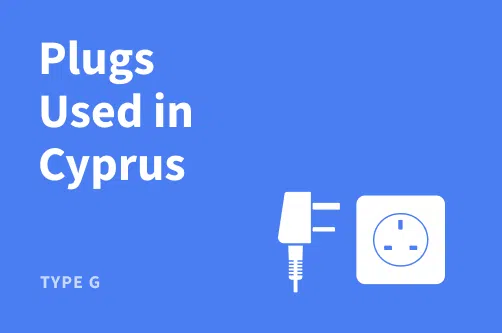
Cyprus uses Type G outlets, the same type of outlet found in the UK. When I traveled there from the US, a plug adapter was definitely part of my travel essentials, while UK travelers can plug in without issue.
The country runs on 230 V / 50 Hz, and from my experience, most modern devices don’t need a voltage converter as long as they support dual voltage. If you’re coming from the EU, Canada, or Australia, you’d need a plug adapter.
The Cyprus plug type is Type G, which you’ll recognize by its three rectangular pins arranged in a triangular shape. It’s the same outlet used in the UK. Cyprus runs on 230 V at 50 Hz, so while US and Canadian plugs won’t physically fit, most modern devices are designed to handle the voltage.
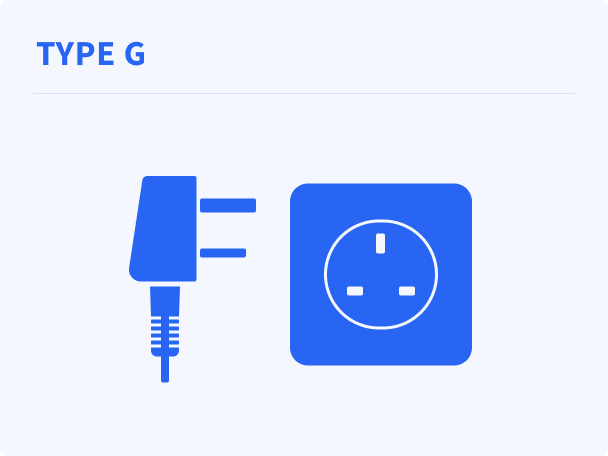
If your device supports 100–240 V, which is the case for most phones, laptops, and cameras, you’ll just need a Type G plug adapter. A voltage converter is only necessary for older or single-voltage devices, which most travelers no longer carry.
If you’re heading to Cyprus, below are some trusted adapter brands compatible with the Cyprus plug type (Type G).
This Type G adapter is built for travel to Cyprus and the UK, with three AC outlets and three USB ports for charging multiple devices at once. It supports up to 250 V input, making it safe for 230 V countries.
The adapter features smart charging, delivering up to 5V / 2.4 A per USB port and USB-C up to 3 A, with 15 W total USB output. It’s rated 4.7/5 from 1,940 reviews and includes a 30-day replacement guarantee.
This adapter allows Type F (EU/Germany) plugs to work in Type G (UK/Cyprus) outlets. The SGU-F3W model includes a built-in fuse for safety. Made in the USA by ACUPWR USA, it ships worldwide and comes with a lifetime warranty plus $10,000 in damage coverage.
This Type G adapter combines a US-style outlet, a USB-A port, and a USB-C port in a compact design. It supports up to 2,500 W (250 V, 10 A), making it suitable for use in 230 V countries like Cyprus and the UK.
The USB-C port delivers up to 30 W with Power Delivery support, while the USB-A port provides up to 18 W. When both USB ports are used simultaneously, they share a total of 30 W. Primo Myth has a 99.7% positive seller rating.
Cyprus uses 230 V at 50 Hz, which is different from the US and Canada but the same as the UK and most of Europe. In most cases, a voltage converter is not needed.
If you’re coming from the US or Canada, you’ll usually only need a plug adapter, as most modern devices (phones, laptops, tablets, cameras) support 100–240 V. If you’re traveling from the UK or EU, you won’t need a voltage converter at all, since the voltage is the same.
A voltage converter is only necessary if you’re bringing an older or high-powered device that runs only on 110–120 V, such as certain hair tools or small appliances. Always check your device label before plugging it in.
Below are four ways you can get mobile internet in Cyprus.
Using data roaming means you rely on your home carrier’s network while abroad. Verizon roaming and AT&T roaming charge around $12 per day for their daily travel pass for Cyprus. Although convenient, roaming can get expensive on longer trips.
An eSIM for Cyprus lets you download a data plan before you travel and activate it instantly. You can choose different eSIM providers, each with its own strengths. For example, Holafly is best for unlimited data, while Airalo is best for flexible travel data plans.
Buying a physical SIM card in Cyprus gives you access to local networks and rates, but usually requires visiting a store, showing ID, and swapping SIM cards, unlike eSIMs. Although most likely cheaper than roaming and eSIM, it’s less convenient if you want internet right away.
A pocket WiFi for Cyprus is a portable router that connects multiple devices at once. It works well for groups, but it requires carrying extra equipment and keeping another device charged.
If you’re wondering which plug types are used in other popular travel destinations, here’s a short table to help you check which kind of plug you’ll need before you go. The image below the table shows what each plug type looks like.
| Plug Type | Destinations |
| Type A | US, Canada, Mexico, Japan |
| Type B | US, Canada |
| Type C | France, Germany, Italy, Spain, Thailand, Iceland |
| Type D | India, Nepal |
| Type E | France, Belgium, Poland |
| Type F | Germany, Netherlands, Spain, Indonesia |
| Type G | UK, Cyprus, Singapore, Hong Kong, Ireland |
| Type H | Israel |
| Type I | Australia, New Zealand, China |
| Type J | Switzerland |
| Type K | Denmark |
| Type L | Italy |
| Type M | South Africa |
| Type N | Brazil |
| Type O | Thailand |
Cyprus uses 230 V at 50 Hz, which is standard across the UK and most of Europe.
Cyprus uses a 3-pin plug. The sockets are Type G, with three rectangular pins arranged in a triangular pattern.
No. Cyprus does not use the standard EU plug types (Type C, E, or F). It uses Type G, which is the UK-style plug.
No. The US uses Type A and Type B plugs, which do not fit Cyprus outlets. Travelers from the US need a plug adapter.
Yes. Cyprus uses the same Type G plugs and the same voltage (230 V / 50 Hz) as the UK.
No. Canada uses Type A and Type B plugs. Canadian travelers will need a Type G plug adapter when visiting Cyprus.

The best global eSIM provider
From $2.3/week
A reliable eSIM provider for budget travelers
From $2.4/week
The best global eSIM provider
From $2.3/week
A reliable eSIM provider for budget travelers
From $2.4/week


Our mission is simple: to make sure you never have to ask, “What’s the WiFi password?” again. All our tips come straight from personal experience — because we’d never recommend something we haven’t put to the test ourselves.
Reviews