

Taking a moment to confirm plug compatibility before departure can save you trouble once you arrive.
Realizing that your charger does not fit the socket in your hotel room can quickly turn into an annoyance, particularly if you need to look up directions, confirm reservations, or contact your driver.
In this guide, you will learn what electrical outlets look like in Slovakia, which adapters are appropriate to bring, and the simplest options for staying connected to mobile internet during your stay.
Slovakia uses Type C and Type F plugs. These plug styles are widely used throughout most of Europe.
Travelers arriving from the United States, Canada, the United Kingdom, Australia, and many Asian countries will need a compatible plug adapter.
Power sockets in Slovakia are built for round-pin plugs, which means flat or rectangular pins from other regions will not fit directly.
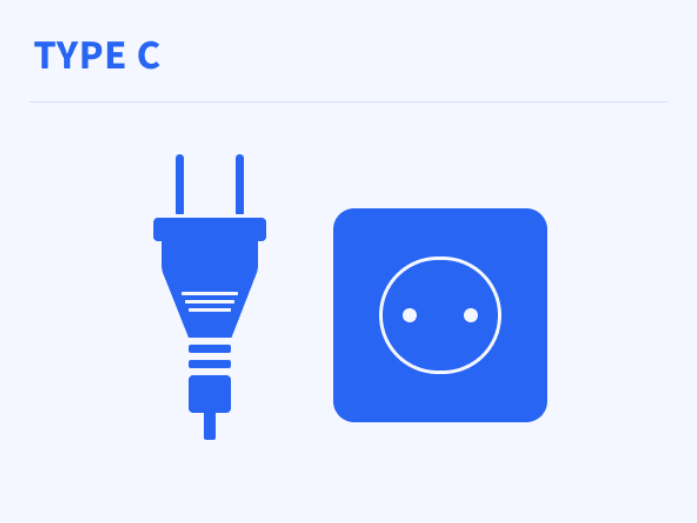
The Type C plug features two round pins and does not include a grounding contact.
It is generally used for smaller devices such as phone chargers, cameras, tablets, and other low-wattage electronics.
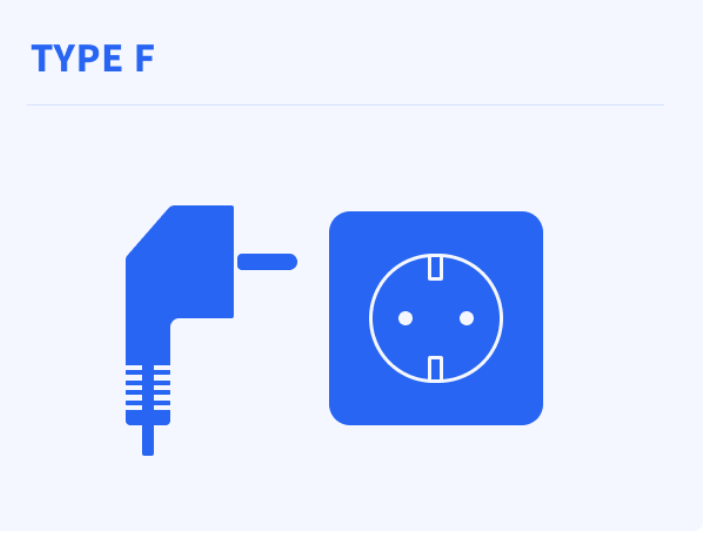
The Type F plug also has two round pins but includes grounding clips on the sides for extra protection.
This grounded design is typically used for larger appliances and higher-powered equipment.
I recommend purchasing a plug adapter online before traveling since it tends to be less expensive and eliminates last-minute scrambling.
If you decide to buy one after you arrive, adapters are available at airports, electronics retailers, and some larger supermarkets in Slovakia.
Here are three dependable and well-reviewed adapters that are suitable for use in Slovakia:
This 5-in-1 European adapter works with Type C outlets commonly found throughout continental Europe. It includes two North American-style outlets along with three USB charging ports, two of which are USB-C.
The USB-C ports support up to 5V/3A, and the USB-A ports provide up to 5V/2.4A, with a total combined USB output of 5V/3.1A.
It is compatible with devices that operate within a 100V to 250V range, but does not function as a voltage converter. A 12-month manufacturer's warranty is included.
This 6-in-1 European adapter converts a single Type C socket into multiple charging options, including two North American outlets, three USB-A ports, and one USB-C port.
It is rated for up to 2500W at 250V and 10A, allowing several devices to be powered at the same time.
The USB-A ports deliver up to 2.4A each, while the USB-C port provides up to 3A, making it suitable for charging smartphones, tablets, laptops, cameras, and power banks.
The adapter is CE and FCC certified and comes with a 12-month warranty.
This Type C adapter is compatible with outlets used in most European countries. It accepts standard North American two- and three-prong flat plugs, including polarized versions.
It supports electrical connections up to 250V but does not convert or step down the voltage. Your devices must be rated for dual voltage between 110V and 240V. Single-voltage 110V appliances, such as certain hair dryers or curling irons, are not suitable.
The adapter includes a 24-month Ceptics warranty.
Generally, no, you won’t need it. Most modern electronics are designed to support a broad voltage range automatically.
Items like smartphones, laptops, tablets, cameras, and power banks commonly accept inputs from 100V to 240V.
If your home country does not use Type C or Type F plugs, you will need a plug adapter so your charger can fit into Slovak outlets.
There are several ways to stay online during your visit, and the best choice depends on the length of your stay and how much data you plan to use.
Roaming allows you to continue using your existing mobile plan while connected to Slovak networks.
You typically only need to activate international roaming with your provider before departure.
Keep in mind that roaming can be costly. Carriers such as Verizon, AT&T, and T-Mobile often offer international day passes that range between $5 and $15 per day.
An eSIM is a digital SIM profile that you install directly onto your phone without inserting a physical card.
Setup is usually straightforward, and in most cases, you will have mobile data shortly after landing.
Companies like Holafly boast unlimited data options, while Vodafone Travel provides prepaid data packages.
For many travelers, using an eSIM is the easiest solution since you can prepare everything before your trip and be connected right away.
See also: Best eSIM for Slovakia
If you are staying for an extended period, purchasing a Slovak SIM card can be a cost-effective option.
You can buy SIM cards at airports or in mobile shops from providers such as Orange, O2, and Telekom. A passport may be required for activation.
Pocket WiFi devices operate as portable hotspots, enabling several devices to share a single data connection.
They can be convenient for families or small groups, but they require carrying and recharging an additional device.
Electrical outlets and voltage standards vary from country to country. Verifying plug type and voltage before departure helps ensure your devices function without issues.
Below is a general summary of widely used plug types around the world:
| Plug type | Countries/regions where used |
| Type A | United States, Canada, Mexico, Japan, Dominican Republic, Costa Rica |
| Type B | United States, Canada, Mexico, Dominican Republic |
| Type C | Most of Europe, Thailand, Indonesia, Slovakia, Portugal, Greece, Austria |
| Type D | India, Nepal, Sri Lanka |
| Type E | France, Belgium, Poland, the Czech Republic, Slovakia |
| Type F | Germany, Spain, the Netherlands, Slovakia, Sweden, Norway, Finland |
| Type G | United Kingdom, Ireland, Singapore, Hong Kong, UAE, Malaysia |
| Type I | Australia, New Zealand, China, Argentina, Fiji, Papua New Guinea |
| Type J | Switzerland, Liechtenstein |
| Type K | Denmark, Greenland |
| Type L | Italy, Chile |
| Type M | South Africa, Lesotho, Eswatini |
| Type N | Brazil, South Africa |
| Type O | Thailand |
If you are planning to explore nearby countries during your trip, it is wise to check plug compatibility for each destination in advance. You can also read our guides on:
Norway offers strong and stable mobile coverage, with fast speeds available across most of the country. Still, each option comes with different trade-offs when it comes to cost, ease of use, and flexibility.
In practice, travelers usually choose between sticking with roaming, picking up a local SIM card, using a pocket WiFi device, or setting up an eSIM ahead of time.
Read on to learn how mobile internet works in Norway and which solution usually works best for visitors.
After looking at the main ways travelers stay connected in Norway, a few things become clear:
For most people visiting Norway in 2026, an eSIM is generally the most convenient and practical option overall.
It offers reliable coverage, transparent pricing, and fast activation without needing to stand in line, complete paperwork, or remove your existing SIM card.
When you’re traveling in Norway, you’ll have a few reliable options to stay connected.
The right option depends on your budget, the length of your stay, and how much setup you are comfortable dealing with.
The main choices include:
Here is how each option usually works for travelers.
An eSIM is built into your phone, so instead of inserting a physical SIM card, you simply install a mobile plan digitally, usually by scanning a QR code. There’s no need to visit a store or swap out your existing SIM.
Once everything is set up, your phone connects automatically to local networks in Norway.
Coverage across the country is generally excellent. 4G is available in most populated areas, while 5G is widely accessible in cities like Oslo, Bergen, and Trondheim.
In terms of performance, speeds are more than enough for everyday use, whether you’re using maps, scrolling social media, making video calls, or even working remotely.
Like any connectivity option, eSIM plans come with a few limitations.:
Tip: Before choosing an eSIM, make sure your phone supports it and that your device is unlocked. If you are unsure which plan to choose, check out our guide on the best eSIMs for Norway.
Verdict: For short trips, business travel, and travelers who want to connect immediately after landing, an eSIM is often the easiest way to get mobile internet in Norway.
Local prepaid SIM cards remain a reliable option in 2026, especially for longer stays.
They are offered by Norway’s main mobile providers, including Telenor, Telia, and Ice.
The biggest advantage is value because data packages are often generous for the price. You also get a Norwegian phone number, which can be helpful for reservations, local services, or business contacts.
The main drawback is convenience. Buying a SIM card usually requires:
SIM cards are available at Oslo Airport, official carrier stores like Telenor and Telia, and electronics retailers such as Elkjøp in major cities like Oslo, Bergen, and Trondheim.
You can also buy them at convenience stores and kiosks like 7-Eleven and Narvesen, and sometimes at gas stations or supermarkets.
Verdict: Best for extended visits, work trips, or travelers who want a Norwegian phone number.
International roaming is still a common choice since it doesn’t require any setup, and your phone connects automatically when you arrive.
However, it is expensive. Travelers from the United States and Canada often pay significantly more when roaming in Norway compared with using local options.
Travelers from the United Kingdom should also review their provider’s EU roaming policies.
Most roaming plans are structured either as daily passes with limited data or as pay-per-use pricing.
Before traveling, it helps to:
Verdict: Convenient for very short trips or emergencies, but not the most cost-effective option.
Pocket WiFi devices are compact portable routers that connect to local mobile networks and let multiple devices share the same internet connection.
They are often promoted as a good option for families or small travel groups. While they may seem convenient at first, using one usually involves:
Rental prices can also be higher than individual eSIM plans, and since most smartphones already support hotspot sharing, pocket WiFi is unnecessary for many travelers.
Best for: Families or groups who want to connect multiple devices at the same time.
Public WiFi is widely available throughout Norway, especially in hotels, cafés, airports, shopping centers, and many public spaces.
While it can be useful, it should not be your primary connection. Speeds may vary, connections sometimes drop, and open networks are not always secure.
Public WiFi works best for light browsing, checking email, and other basic online tasks. For better security, it’s also a good idea to use a VPN and avoid logging into financial accounts on open networks.
Best for: Using it occasionally as a backup connection.
Costs depend on the option you choose and how much data you use. The table below shows typical weekly pricing for travelers in 2026.
| Option | Typical cost per week |
| eSIM | $8–$22 |
| Local SIM | $5–$12 |
| Pocket WiFi | $55–$75 |
| Roaming | $50 to $120+ |
When convenience, setup time, and flexibility are considered together, eSIMs usually provide the best overall value for short trips.
It’s easy to misjudge how much data you’ll actually need, so the best way to estimate it is by looking at how you use your phone day to day.
Light users typically stick to maps, messaging apps, and email, which usually comes out to around 1–2 GB per day.
Moderate users spend more time on social media, browsing, and short videos, so 2–4 GB per day is a more realistic range.
Heavy users, including remote workers or those who often use hotspot, should plan for 5 GB per day or more.
Tip: To stretch your mobile data further, you can:
Choosing the right SIM card in the Caribbean depends on your travel style. I compared options for price, data amounts, validity, and network coverage. Buying a SIM at an airport kiosk is convenient, though local shops often have more choices. I focused on prepaid cards that actually work for travelers, covering everyday needs like maps, messaging, and social apps.
Quick pick: the best SIM card for the Caribbean is Digicel, because it offers broad coverage, good value, and is simple to buy across multiple islands. Local SIMs are cheaper than eSIMs, but they usually need a passport or a store visit, and a few minutes to activate before you are online.
Note *All pricing information in this article is accurate as of March 2, 2026. Prices are subject to change at any time, so we recommend checking directly with each SIM and eSIM provider for the most up-to-date details before making a purchase.*
Quick verdict: For most travelers, a Digicel prepaid SIM is the easiest way to stay connected across Caribbean islands. You buy the SIM and pick a bundle, from 7 GB for a week to unlimited Prime Ultra for heavy use. Flow starts at US $5 for 2 GB in Saint Kitts, while Claro in the Dominican Republic offers 3–20 GB plus bonus minutes depending on your recharge.
If you want a longer tourist-friendly bundle with data and calls, Digicel’s unlimited 3‑day Prime Ultra plan or Flow’s top-up packs are convenient. Budget travelers can use Flow’s 2 GB / US $5 plan or Claro’s smaller recharge options for light browsing and messaging.
| Provider | Price (from) | Data | Validity | Network coverage in Costa Rica | Where to buy | Best for |
| Digicel | XCD 20 ($7.40) | 3GB | 3 days | Works across many Digicel territories | Digicel stores, airport kiosks | Short trips & basic data |
| Flow | $2.00 | 2 GB | 7 days | Good coverage on Flow islands | Flow stores & local shops | Budget data & calls |
| Claro | RD$ 0.13($0.22) per second | RD$ 1.50 ($2.52) /MB + free Navigation | Depends on recharge | Broad coverage in DR | Claro stores, airport kiosks, authorized retailers | Claro stores, airport kiosks, authorized retailers |
Airport convenience: Digicel has kiosks and stores at some airports, so you can get connected immediately after landing on islands where it operates. Flow and Claro generally require a city store visit to buy the full prepaid packs or activate bonus data.
Best value: Flow’s 2 GB / US $5 plan is ideal for budget-conscious travelers who need messaging, light browsing, and some local minutes without spending much.
Longer stays or heavier data: Digicel’s unlimited 3‑day Prime Ultra plan or larger top-up bundles provide the most data plus voice/SMS, perfect for extended trips or heavy app usage across islands.
Short trip, hassle-free: For trips under a week, Claro’s smaller prepaid recharges in the Dominican Republic or a Digicel short-term bundle allow immediate connectivity without hunting for a store.
For travelers, these three providers, Digicel, Flow, and Claro, offer the best mix of coverage, value, and tourist-friendly options. Digicel works across multiple islands, Flow is ideal for budget trips and smaller islands, and Claro provides reliable service in the Dominican Republic.
Exact plans, data, and prices can change, so it is important to confirm details in-store or on the official carrier website before buying a SIM.

Digicel is one of the largest mobile carriers in the Caribbean. It operates in multiple islands including Dominica, Saint Lucia, Grenada, and Antigua. The network is known for strong coverage in urban areas and major tourist spots, as well as decent rural reach. Digicel offers a variety of prepaid plans suitable for short stays and longer trips.
The carrier is popular with travelers who need reliable mobile data across several islands. Digicel’s SIM cards are easy to buy at airport kiosks, Digicel stores, and authorized retailers. It is best for visitors who need fast internet, unlimited social apps, and voice/SMS across multiple islands without worrying about roaming.
| Duration | Data | Pricing | Notes |
| 3 days | 3GB+ free incoming calls | XCD 20 ($7.40) | Short stay bundle with data and free incoming calls |
| 7 days | 7GB+ free incoming calls | XCD 40 ($14.80) | Mid‑length plan with enough data for maps and messaging |
| 14 days | 14GB+ free incoming calls | XCD 80 ($29.60) | Longer stay plan with large data allowance |
| 7 days | Unlimited | XCD 40 ($14.80) | Unlimited data for heavy browsing and apps |
Quick verdict: Digicel is best for travelers visiting multiple Caribbean islands who need strong coverage and heavy data. The main trade-off is that short-term bundles are slightly more expensive than local island-only providers. You can buy the SIM at airport kiosks, Digicel stores, or authorized retailers.

Flow is a well‑known mobile network operating in many Caribbean islands, including St. Kitts & Nevis, Barbados, Saint Vincent & the Grenadines, and more. Its prepaid plans combine data, voice calls and SMS in simple bundled options. Flow is popular with budget‑minded travelers and locals alike for basic connectivity and messaging.
Coverage is generally strong in populated areas and major tourist zones on islands where Flow operates. SIM cards are widely available in Flow stores and local shops. Plans typically include unlimited social data on apps like WhatsApp or TikTok. This makes Flow a good choice for visitors who want simple, reliable mobile service with inclusive features without spending too much.
| Duration | Data | Pricing | Notes |
| 1 days | 2 GB (+ unlimited social data) | $5.00 | Basic day plan with calls & SMS |
| 3 days | 4 GB (+ unlimited social data) | $15.00 | Good for short trips, includes calling |
| 7 days | 10 GB (+ unlimited social data) | $25.00 | Mid‑range plan with extras |
| 30 days | 15 GB (+ unlimited social data) | $100.00 | Long‑stay option |
Quick verdict: Flow is best for travelers who want affordable data, voice, and SMS with extra social app allowances on islands like St. Kitts & Nevis. The main trade‑off is that coverage can be strongest in towns and tourist hubs rather than very remote areas, and plans vary by island. You can buy a SIM at Flow stores and local shops once you arrive.
Claro Dominicana is one of the main mobile carriers in the Dominican Republic. Their prepaid (Prepago) service lets you recharge your balance and get data plus bonus minutes without a contract. Claro’s network covers most of the country. It reaches urban areas and many tourist destinations with 4G/LTE and 5G speeds.
Prepaid plans are flexible. You can get up to 20 GB plus bonus minutes depending on your recharge. Smaller data packages are available for social apps or browsing. SIM cards and recharges are easy to find at Claro stores and authorized retailers. This makes Claro a practical choice for travelers focusing on the Dominican Republic.
| Duration | Data | Pricing | Notes |
| Depends on recharge | RD$ 1.50 ($2.52) /MB + free Navigation | RD$ 0.13($0.22) per second | Add-ons and packages can extend data or bonus minutes. Buy at Claro stores, authorized retailers, or airport kiosks. |
Note: *Claro doesn’t display all exact prepaid bundles in a single table on its website, but recharges starting at RD$150 give you data and bonus benefits depending on your balance.*
Quick verdict: Claro is best for travelers spending most of their time in the Dominican Republic who want cheap data and occasional calls with flexible recharges. The main trade‑off is that bundles must be activated after recharge, and larger data packs may require a visit to a Claro store or authorized retailer.
During my trip, I tried relying entirely on local SIM cards, but they usually took more steps than expected. Finding the right store, registering with a passport, and activating the plan all added extra time to my first day on the islands.
Here’s a breakdown of the main options:
Tip: Always test your SIM before leaving. Make sure data and social apps like WhatsApp or Google Maps work. Activation usually takes a few minutes.
During my travels in the Caribbean, I tested several eSIM options as an alternative to buying local SIM cards. Setting up a local SIM took extra time for finding a store, registering with my passport, and activating the plan. eSIMs felt easier because I could buy, install, and start using them before I even landed.
eSIMs make even more sense for short trips or multi‑island itineraries because you do not need to swap physical SIMs. From my experience, the setup is fast, you avoid store visits, and data often kicks in right after activation. This convenience, combined with solid coverage and flexible data packages, made eSIMs a better fit for quick Caribbean trips.
| Provider | Best for | Notes |
| Holafly | Travelers who need unlimited data | Great if you want unlimited data without worrying about usage limits. Setup is fast and simple, and it works right after installation. |
| Airalo | Budget-conscious or short trips | Works well if you want flexible plans at low prices. Installation is easy, and it activates immediately.. |
| Nomad | Frequent travelers or multi-country trips | Works well if you want a single eSIM that can be used in several countries. Plans are flexible, and setup is straightforward. |
Quick take: Holafly is ideal for travelers who want unlimited data and a hassle-free setup. Airalo works well for short trips or budget-conscious travelers who need flexible plans. Nomad is great for multi-country itineraries with predictable data and easy activation.
Italy has plenty of SIM card options, but Vodafone, TIM, and WINDTRE stand out for their tourist-specific plans, strong coverage, and high data allowances.
I looked at price, data, validity, network coverage, where to buy, and activation requirements, focusing on options designed for short-term visitors.
In practice, local SIM cards are often among the cheapest ways to stay connected, but getting one usually involves a short in-store setup before you can start using it. Because of this, eSIMs can still be the more convenient choice, especially for shorter trips.
Quick pick: The best SIM card for Italy is Vodafone Italy’s Dolce Vita plan.
Quick verdict: Vodafone Italy offers the best overall value, with 200GB of data, no activation fee, and strong nationwide coverage, making it the most straightforward option for most travelers.
| Provider | Price (from) | Data | Validity | Network coverage in Italy | Where to buy | Best for |
| Vodafone Italy | €14.95 (~$16) | 200GB (Dolce Vita) | 30 days | Nationwide 4G/5G network | Vodafone stores, airports | Best overall value, high data |
| TIM | €14.99 (+€10 SIM) (~$16 + ~$11 SIM) | 200GB (TIM Tourist) | 30 days | Extensive national coverage | TIM stores, airports | Coverage and reliability |
| WINDTRE | €25.00 (~$27) | 200GB | 30 days | Strong coverage in cities and tourist areas | WINDTRE stores, retailers, online | Flexible plans, longer stays |
Choosing the right SIM card in Italy depends on how much data you need and where you’ll be traveling.
Pro tip: If you’re visiting multiple cities like Rome, Florence, and Venice, check this Italy itinerary to estimate how much data you’ll need throughout your trip.
The best SIM card for Italy typically comes from Vodafone, TIM, or WINDTRE, thanks to their dedicated tourist plans, strong nationwide coverage, and high data allowances.
These providers offer straightforward 30-day bundles designed for short-term stays, often including data, calls, and EU roaming.
Note: Since pricing and inclusions can change, it’s best to confirm the latest details in-store or on each provider’s official website before buying.
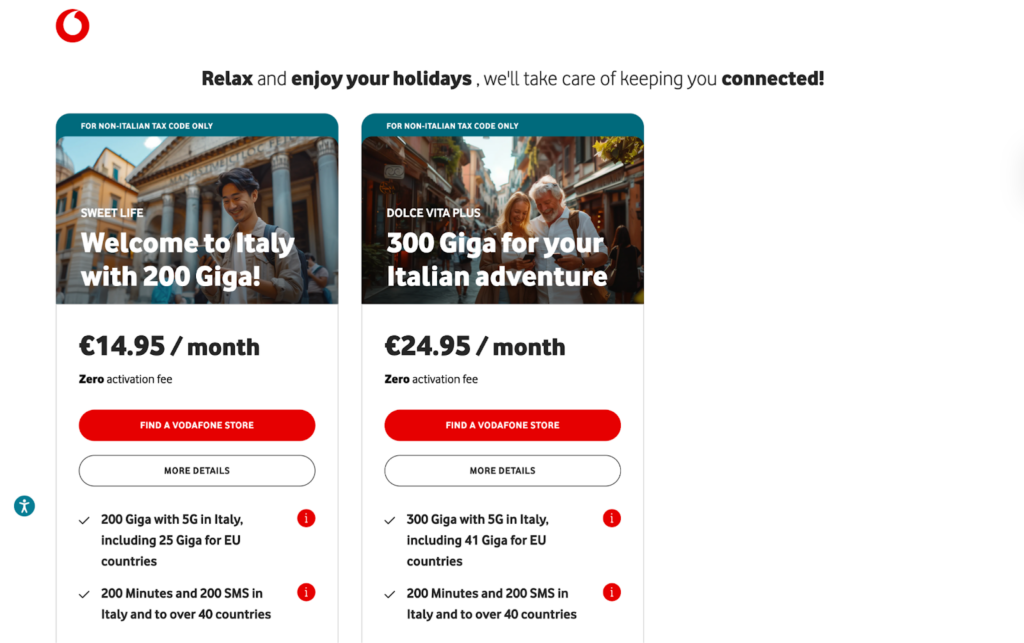
Vodafone is one of Italy’s leading telecom providers with strong nationwide 4G and 5G coverage. Its Dolce Vita plans are designed specifically for tourists, offering high data allowances along with included minutes and SMS to both local and international numbers. It’s best suited for travelers who want a simple, high-data plan without needing to compare multiple options.
Plans & pricing
| Duration | Data | Price | Notes |
| 30 days | 200GB | €14.95 (~$16) | Includes 25GB EU roaming, 200 minutes and 200 SMS (Italy + 40+ countries), zero activation fee |
| 30 days | 300GB | €24.95 (~$27) | Includes 41GB EU roaming, 200 minutes and 200 SMS, zero activation fee |
Quick verdict: Best for overall value and ease of use with high data at a low price. Available at Vodafone stores and airports, with plans designed specifically for tourists.

TIM (Telecom Italia) is Italy’s largest telecom operator and is widely known for its extensive nationwide coverage, including smaller towns and rural areas. Its TIM Tourist plan includes a high data allowance with unlimited domestic calls and a set number of international minutes, making it a reliable and well-rounded option for visitors. It’s particularly suited for travelers moving between major cities and less populated regions.
Plans & pricing
| Duration | Data | Price | Notes |
| 30 days | 200GB | €14.99 (+€10 SIM) (~$16 + ~$11 SIM) | Includes unlimited domestic calls and 100 international minutes, EU roaming included |
| 30 days | 200GB (5G ULTRA) | €19.99 (+€10 SIM) (~$22 + ~$11 SIM) | Optional upgrade with 5G ULTRA for €5 more |
Quick verdict: Best for reliable coverage across Italy, especially outside major cities. Available at TIM stores and airports, with a one-time SIM cost and in-store activation required.
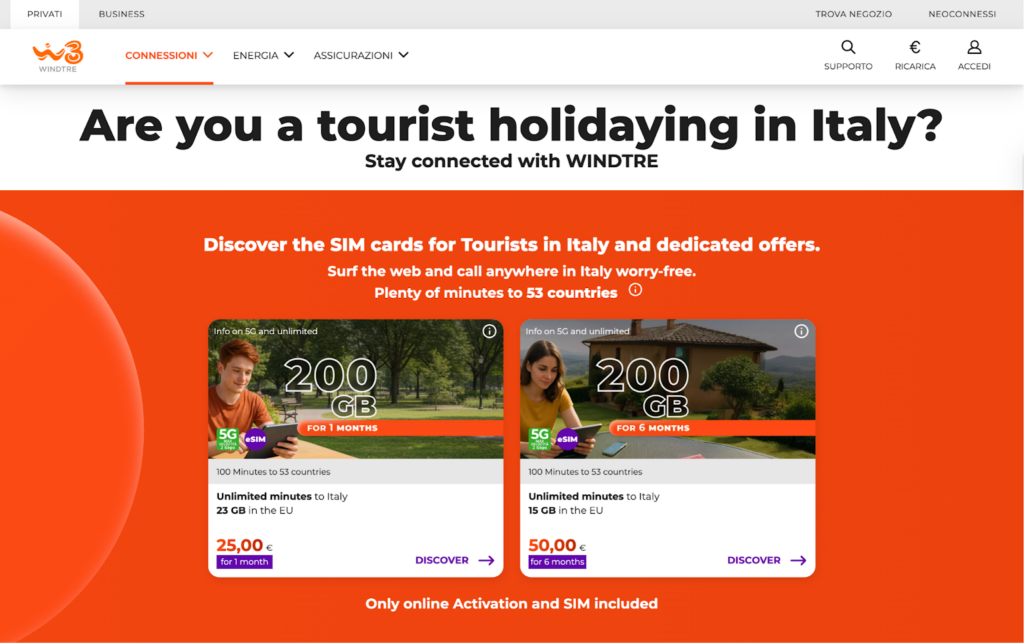
WINDTRE is one of Italy’s major telecom providers, offering tourist SIM plans with strong nationwide coverage and large data bundles. Its offers are designed specifically for visitors, including unlimited local calls and international minutes to over 50 countries. It’s a good option for travelers who want flexible plans, including both fixed high-data bundles and longer-duration options.
Plans & pricing
| Duration | Data | Price | Notes |
| 30 days | 200GB | €25.00 (~$27) | Includes unlimited calls in Italy, 100 international minutes, ~23GB EU roaming |
| 6 months | 200GB | €50.00 (~$54) | Longer-term option, includes unlimited local calls and EU roaming |
Quick verdict: Best for flexible durations and high data bundles. Available online (with eSIM or store pickup) or at WINDTRE stores across Italy.
Using a local SIM card in Italy is fairly straightforward, but it usually takes a bit more time than expected since setup is often done in-store.
I’ve found that going directly to a provider store is the most reliable way to avoid activation issues, especially in busy cities like Rome or Milan.
eSIMs are usually the fastest way to get connected in Italy, especially if you don’t want to deal with finding a store or waiting for setup.
Instead of buying a physical SIM and going through activation, you can download a plan before your trip and have data ready as soon as you land.
After trying a few eSIM options across different trips, the biggest advantage is how seamless everything feels.
There’s no need to swap SIM cards or rely on store hours, and you can manage everything directly from your phone. Whether you choose unlimited data or a smaller fixed plan, the flexibility makes eSIMs a practical alternative to local SIMs.
Quick eSIM comparison
| Provider | Data style | Price (from) | Best for | |
| Holafly |  | Unlimited data | $3.90/day | Heavy data, no limits |
| Nomad |  | Fixed GB / unlimited | $4.50 (1GB) | Budget, flexible plans |
| Orange Travel |  | Fixed GB / unlimited | $1 (1GB) | Data + calls in Europe |
Reviews (based on testing and usage)
Note: These observations come from using each option in real travel situations, including short city trips and longer stays.
I compared local SIM cards in Spain across price, data allowances, validity, and network coverage, focusing on options from Vodafone Spain, Orange Spain, and Movistar.
Physical SIM cards are often among the cheapest ways to stay connected while traveling in Spain. All three providers operate nationwide networks, making them reliable options depending on your needs.
Quick pick: The best SIM card for Spain is Vodafone Spain for its strong coverage, high data allowance, and easy availability at airports and city stores.
For heavy data use, Vodafone Spain is the best choice thanks to its high-data prepaid bundles and flexible options.
| Provider | Price (from) | Data | Validity | Network coverage in Spain | Where to buy | Best for |
| Vodafone Spain | €10 (~$11) | 90GB (Prepago S) | 28 days | Nationwide 5G network | Online order, Vodafone stores, delivery or pickup | Heavy data, flexible plans |
| Orange Spain | €10 (~$11) | 80GB (Prepago 10) | 28 days | Strong in cities and tourist areas | Orange stores, airports, retailers | High data at lower price |
| Movistar | €10 (~$11) | 60GB (Prepaid Plus) | 28 days | Extensive national coverage | Official stores, retailers | Reliable coverage |
Choosing the best SIM card in Spain comes down to value, flexibility, and coverage.
Pro tip: If you’re planning your route across cities like Barcelona, Madrid, and Seville, check this Spain itinerary to estimate how much data you’ll actually need during your trip.
Vodafone stands out by offering the highest data allowance at the same starting price, along with flexible prepaid tiers that make it easy to scale your plan.
Orange is a close alternative with slightly less data but similar pricing, while Movistar offers lower data at the entry level but more consistent nationwide coverage, especially outside major cities.
All three require in-store purchase and passport registration for activation, so your choice ultimately depends on whether you prioritize higher data allowances or stronger nationwide coverage.
Spain’s three main mobile operators, Vodafone Spain, Orange Spain and Movistar, offer the best prepaid SIM options thanks to their strong nationwide coverage, competitive pricing and widely available plans.
These providers all offer 28-day prepaid bundles with large data allowances and international minutes included. Keep in mind that exact bundles and promotions can change, so it’s best to confirm details in-store or on the official provider websites.

Vodafone is one of Spain’s largest telecom providers and offers a wide range of prepaid plans with high data allowances and flexible tiers. Its prepaid bundles include large data packages, unlimited national calls, and international minutes, making it a strong all-around option. It’s best suited for travelers who want maximum data and flexibility across different plan levels.
Plans & pricing
| Duration | Data | Price | Notes |
| 28 days | 90GB | €10 (~$11) | Prepago S, includes unlimited national calls and international minutes |
| 28 days | 270GB | €15 (~$16) | Prepago M, higher data + more international minutes |
| 28 days | 330GB+ | €20+ (~$22+) | Higher tiers available (L, XL, XXL) |
Quick verdict: Best for heavy data users who want the most value at the lowest price. Widely available online with delivery or at Vodafone stores, though setup requires registration.

Orange is another major provider in Spain, known for its competitive prepaid pricing and high data allowances. Its prepaid plans include generous data, unlimited national calls, and international minutes, making it a strong value option. It’s especially suitable for travelers who want a balance between price and data without needing multiple plan tiers.
Plans & pricing
| Duration | Data | Price | Notes |
| 28 days | 80GB | €10 (~$11) | Prepaid 10, includes international minutes and EU roaming |
| 28 days | 260GB | €15 (~$16) | Prepaid 15, larger data bundle |
| 28 days | Unlimited | €35 (~$38) | Holiday Maxi (tourist-focused plan) |
Quick verdict: Best for budget-conscious users who still want high data. Available in Orange stores, airports, and retailers, though activation requires in-person registration.

Movistar is Spain’s largest telecom network and is widely recognized for its extensive nationwide coverage. Its prepaid plans offer solid data bundles, unlimited calls, and international minutes, though with slightly less data at the entry level compared to competitors. It’s ideal for travelers prioritizing reliable coverage, especially outside major cities.
Plans & pricing
| Duration | Data | Price | Notes |
| 28 days | 60GB | €10 (~$11) | Prepaid Plus, includes unlimited calls and international minutes |
| 28 days | 240GB | €15 (~$16) | Premium prepaid plan |
| 28 days | 300GB | €20+ (~$22+) | Total prepaid plan |
Quick verdict: Best for reliable coverage across Spain, particularly in rural areas. Available at official Movistar stores and retailers, with activation required in person.
Using a local SIM in Spain is straightforward, but it usually involves a few extra steps like ID registration and in-store activation, which can take more time than expected.
Pro tip: Make sure your phone stays charged while setting up your SIM, especially at the airport. Spain uses Type C and F plugs, so check this Spain plug type guide to see if you’ll need an adapter.
For the quickest setup, it’s worth asking your hotel or accommodation concierge which nearby store can activate a SIM immediately.
From testing different connectivity options while traveling, eSIMs consistently end up being the easier choice compared to SIM cards.
You can install an eSIM in minutes and get online instantly. This makes a big difference on shorter trips when you just want a reliable connection without the extra steps.
In my experience, after trying a few eSIM providers, they simply make more sense for convenience and speed. You keep your main SIM, avoid store visits, and can switch plans digitally.
Based on that experience, here’s how some of the most popular eSIM options compare:
Reviews (based on testing and usage):
Quick eSIM comparison
| Provider | Data style | Price (from) | Best for | |
| Holafly | | Unlimited data | $3.90/day | Heavy data, no limits |
| Nomad | | Unlimited data / Fixed GB | $4.50 (1GB) | Budget, flexible plans |
| Ubigi |  | Unlimited data / Fixed GB | $5 (3GB) | Speed and reliability |
eSIM has quickly become a standard feature on modern iPhones, letting you activate mobile plans digitally without using a physical SIM card.
Apple accelerated this shift with the iPhone 14 in the United States, which removed the physical SIM slot entirely. Because of this change, understanding how eSIM works on iPhones is more important than ever.
The key thing to know is that there is a difference between stored eSIM profiles and active eSIMs.
Your iPhone can store multiple eSIM profiles that you can switch between, but only a limited number can be active and connected to a network at the same time.
If you are wondering how many eSIMs you can have on your iPhone in 2026, let me walk you through how this works across different iPhone generations.
Early eSIM iPhones allow you to store multiple eSIM profiles, but they can only run one eSIM at a time. However, that does not mean these phones support only one active line overall.
In most regions, these iPhones support dual SIM with one physical SIM and one eSIM active simultaneously.
These models include:
With these devices, you can typically use:
This means you still get two active phone lines. The main limitation is that you cannot run two eSIMs at the same time.
It is also worth knowing that hardware varies by region. For example:
So, depending on where your phone was purchased, the SIM configuration might be slightly different.
See also: How to install and activate eSIM on iPhone and Android (2026)
Apple expanded eSIM functionality starting with the iPhone 13 lineup, which introduced the ability to run two eSIMs simultaneously.
This made it possible to use dual SIM entirely through eSIM without relying on a physical SIM card.
These iPhones support two active eSIMs:
On these models, you can usually run:
Starting with the iPhone 14 sold in the United States, Apple removed the SIM tray entirely. These devices rely completely on eSIM.
In other regions, many iPhone models still include a physical SIM slot alongside eSIM support. Because Apple often releases region-specific hardware, the exact SIM configuration can vary depending on where the device was purchased.
For newer generations like the iPhone 16 and iPhone 17, current information indicates they continue supporting dual active eSIM, although regional variations may still exist.
See also: How to use eSIM on iPhone: Ultimate guide
The table below summarizes how eSIM works across major iPhone generations.
It shows how many eSIMs can be active at once, how many profiles can usually be stored, and whether the device includes a physical SIM slot.
| iPhone Model | Max Active eSIMs | Max Stored Profiles | Physical SIM | eSIM only? |
| iPhone XR | 1 | 8+ | Yes (most regions) | No |
| iPhone XS / XS Max | 1 | 8+ | Yes (most regions) | No |
| iPhone 11 series | 1 | 8+ | Yes (most regions) | No |
| iPhone SE (2nd gen) | 1 | 8+ | Yes (most regions) | No |
| iPhone 12 series | 1 | 8+ | Yes (most regions) | No |
| iPhone 13 series | 2 | 8+ | Yes (most regions) | No |
| iPhone SE (3rd gen) | 2 | 8+ | Yes (most regions) | No |
| iPhone 14 series | 2 | 8+ | Yes (outside the U.S.) | Yes (U.S.) |
| iPhone 15 series | 2 | 8+ | Yes (outside the U.S.) | Yes (U.S.) |
| iPhone 16 series* | 2 | 8+ | Likely yes outside the U.S. | Likely yes in the U.S. |
| iPhone 17 series* | 2 | 8+ | Likely yes outside the U.S. | Likely yes in the U.S. |
*Details for the newest generations can vary slightly by region and carrier, but current information indicates continued support for dual active eSIM.
It is important to understand that stored eSIM profiles are not the same as active eSIMs.
Your iPhone can keep several plans saved on the device, but only one or two can actually connect to a cellular network at the same time, depending on the model.
Turkey is well covered by 4G across its major cities and tourist routes, which means pocket WiFi works well here when you pick the right provider. The appeal is the same as anywhere else: one device, one password, everyone connected without touching a SIM tray or dealing with carrier unlock settings.
That said, pocket WiFi makes the most sense when you're splitting the cost. A family or a group of friends sharing a single daily rental fee is a smart call, the per-person cost comes right down.
But after testing current eSIM options for Turkey alongside the rental route, my honest take is this: for solo travelers and couples, pocket WiFi is usually more friction than it's worth.
Here are six verified providers offering pocket WiFi that covers Turkey, along with what each one actually delivers on pricing, logistics, and data.
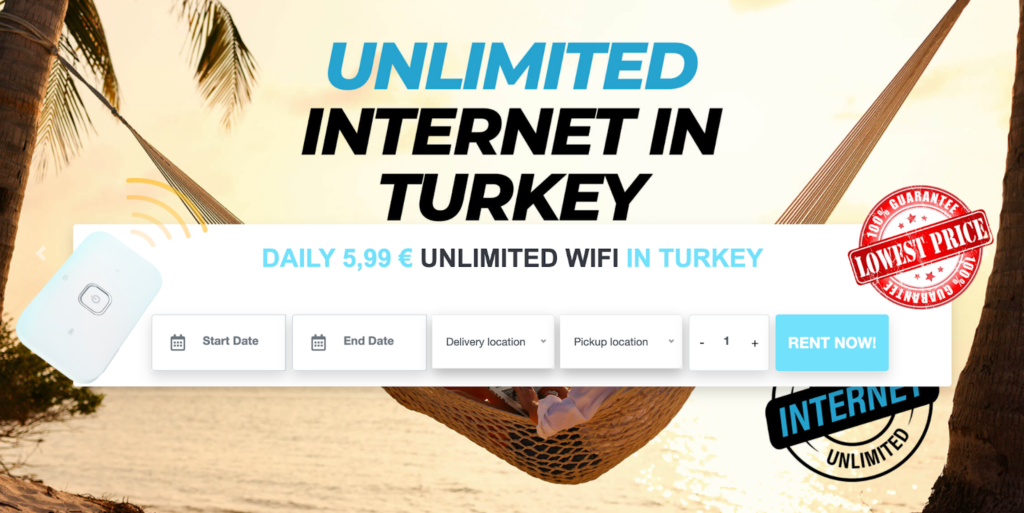
Pocket WiFi Turkey is a Turkey-based provider and official Turkcell agent, which means the device runs on one of the country's main carrier networks. At €5.99/day for unlimited data, it's straightforward to book, and the delivery setup is more hands-on than most.
A delivery person comes directly to your hotel or airport location to hand over the device and register the SIM in person. They also come to collect it from you on your return day, so there's no envelope to find or a post office to visit.
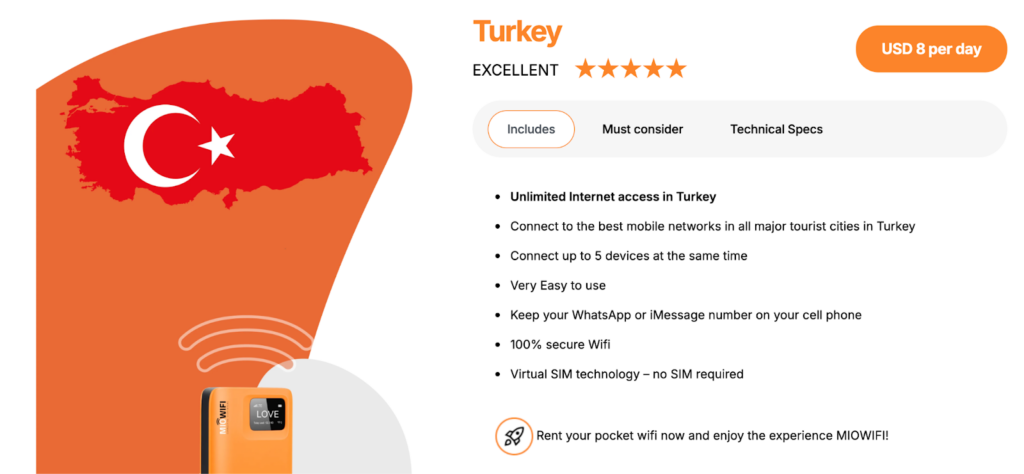
MIOWIFI covers Turkey as part of their 150+ country network, using virtual SIM technology so there's no physical SIM card required. The device runs on 4G speeds, connects up to 5 devices at once, and has a 5,000 mAh battery rated for 12 hours of continuous use.
They charge the same daily rate regardless of which country you're in, which makes budgeting straightforward if Turkey is one stop on a longer trip.
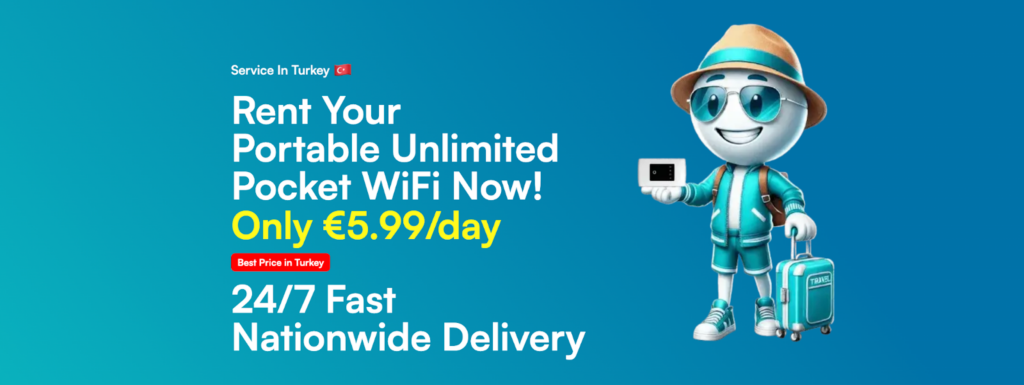
Stay in Wifi is a Turkey-focused provider offering unlimited 4G/5G internet at €5.99/day, the same price as Pocket WiFi Turkey. What sets them apart is their pickup and return network, which covers both Istanbul airports, Trabzon Airport, a Bursa office, and hotel or Airbnb delivery anywhere in the country.
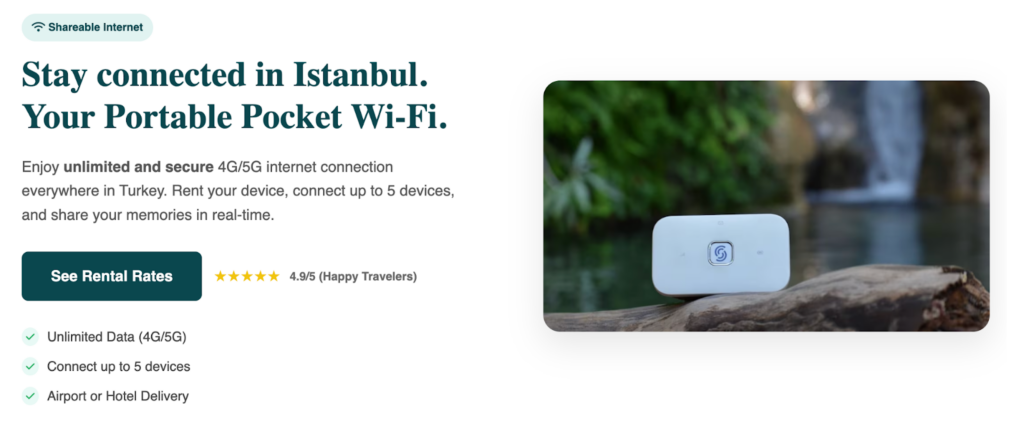
ExplorerVia is a France-based provider offering pocket WiFi specifically for Turkey, with a personal airport meet-and-greet service that's a step above most rental setups.
When you land at Istanbul Airport or Sabiha Gokcen, a team member waits for you at baggage claim with a sign showing your name and hands you the device ready to use. Pricing drops the longer you stay, which makes it a good option for trips of a week or more.
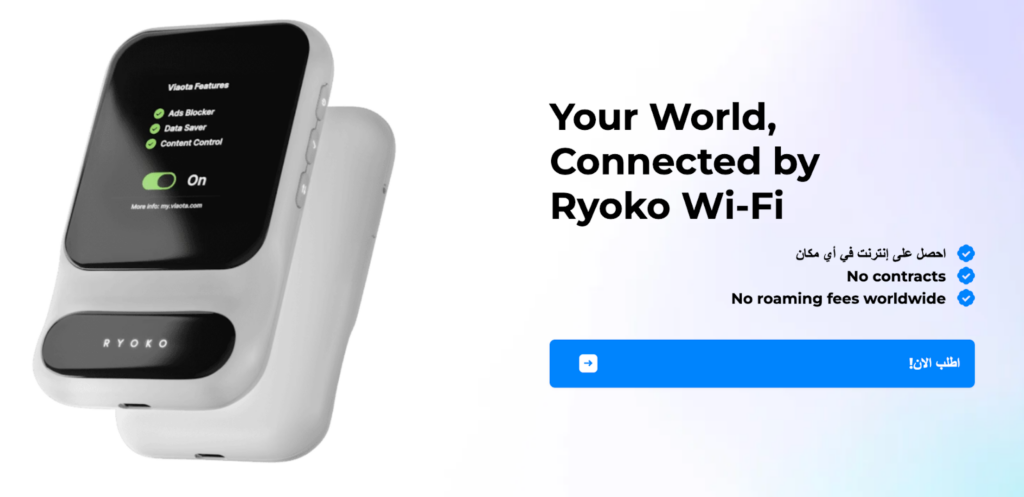
Ryoko is a portable WiFi device you buy outright rather than rent, which means no returns, no deposits, and no logistics to manage. It works in 176 countries including Turkey, automatically connecting to the strongest available network wherever you are.
The device includes a built-in ad blocker and data saver, which is a nice extra you don't usually see on rental units.
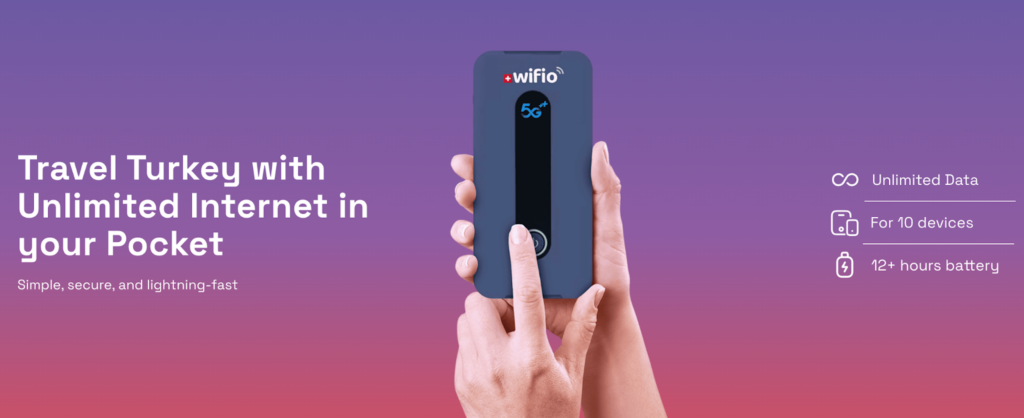
Wifio is run by Fresh Internet GmbH out of Aarau, Switzerland, and their Global device covers Turkey among 150+ destinations.
With 12+ hours of battery and unlimited data, it's a dependable pick, particularly suited to travelers departing from or transiting through Switzerland, where the pickup network is exceptionally convenient. The Global device also ships worldwide to home or hotel.
| Provider | Price | Coverage | Devices | Battery | Data |
| Pocket WiFi Turkey | €5.99/day | Turkey | 10 | not stated | Unlimited |
| MIOWIFI | $8/day | 150+ countries | 5 | 12 hours | Unlimited 4G |
| Stay in Wifi | €5.99/day | Turkey | 5 | 8-10 hours | Unlimited 4G/5G |
| ExplorerVia | €7.99–€9.99/day | Turkey | 5 | 6–8 hours | Unlimited 4G/5G |
| Ryoko | From €0.66/day | 176 countries | 10 | 8 hours | Unlimited 4G |
| Wifio | From €2.25/day | 150+ destinations | 5 | 12+ hours | Unlimited |
Pocket WiFi still works for some trips, but plenty of travelers are skipping it now, and it’s easy to see why. Carrying one more device, keeping it charged all day, and dealing with returns before your flight home can feel like more hassle than it’s worth.
That’s especially true in Turkey, where staying connected has gotten a little more complicated lately.
Before you pick a provider, read more about Turkey banning global eSIM providers and what it means for travelers in the full article.

Holafly is built specifically around unlimited data plans, which means you're not watching a gigabyte counter mid-trip. Setup runs through their app: scan a QR code, follow the prompts, and you're typically active within a few minutes.
They're one of the most widely used eSIM providers among international travelers for good reason.
Airalo is the largest eSIM marketplace globally, with coverage across 200+ countries and one of the most competitive pricing structures available for Turkey. Their regional plans make it a strong option if Turkey is one stop on a broader trip through Europe or the Middle East.
Nomad offers flexible eSIM plans with some of the most competitive per-GB pricing available for Turkey. The app is clean and well-designed: buying, activating, and tracking your data takes a few taps. A reliable middle-ground option that doesn't require you to over-commit to data you might not use.
Sorting out mobile data is often one of the first things travelers think about before traveling to New York City.
Mobile internet across NYC is fast and widely available in 2026, though not every option offers the same balance of price, convenience, and flexibility.
Most travelers usually choose between international roaming, buying a local SIM card after arriving, renting a pocket WiFi device, or installing an eSIM.
Below is a simple breakdown of how mobile internet works in NY and which option tends to make the most sense for most travelers.
After going through the most common ways travelers stay connected in NY, a few clear points become obvious:
For most travelers visiting New York in 2026, an eSIM tends to be the easiest and most practical option overall.
It provides reliable coverage, transparent pricing, and quick activation without needing to visit a store, complete paperwork, or remove your existing SIM card.
When you’re in New York City, there are several reliable ways to get online.
The right choice depends on your budget, the length of your stay, and how much setup you want to deal with.
The main options include:
Here is how each option works in practice.
An eSIM is already built into your phone, so instead of inserting a physical SIM card, you download a mobile plan directly to your device, usually by scanning a QR code. There’s no need to visit a store or remove your current SIM.
Once it’s set up, your phone connects automatically to major mobile networks in New York City.
Coverage across NYC is strong, with 4G LTE available throughout the city and 5G widely accessible across areas like Manhattan, Brooklyn, and Queens.
Speeds are fast enough for everyday use, whether you’re using social media, checking maps, making video calls, or even working remotely.
Like any option, though, eSIM plans do come with a few limitations:
Tip: Before you go with an eSIM, check that your phone is compatible and not locked to a carrier. If you’re unsure which option to pick, reviewing a guide to the best eSIMs for New York can make the choice easier.
Verdict: If you’re staying for a short time, traveling for business, or simply want to be connected as soon as you land, an eSIM is usually the easiest and most hassle-free option in NY.
Local prepaid SIM cards are still a good option in 2026, especially if you’re staying a bit longer. You can get them from major U.S. carriers like Verizon, AT&T, and T-Mobile.
One of the main benefits is value, since data plans are often generous for the price. They also come with a U.S. phone number, which can be helpful for things like reservations and local services, delivery apps, or local contacts.
The downside is convenience. Buying a SIM card usually means:
SIM cards are widely available at airports serving New York City, mobile carrier stores, as well as electronics shops and convenience stores.
Verdict: Best for longer stays and travelers who want a U.S. phone number during their trip.
International roaming is still popular because it doesn’t require any setup before your trip. Your phone connects automatically once you land, in most cases.
The downside is the cost. Travelers from Europe, Canada, and other regions often pay much more when using roaming in the United States compared to choosing a local option.
With apps like maps, messages, and updates running in the background all day, your data can get used up faster than you might expect.
Before traveling, it’s a good idea to:
Verdict: It works well for very short trips or emergencies, but it’s usually not the best value.
Pocket WiFi devices are small portable routers that connect to local mobile networks and allow several devices to share the same internet connection.
They are often advertised as a practical option for families or small groups traveling together.
While they can seem convenient, using one usually comes with a few practical drawbacks:
Pocket WiFi rentals are usually more expensive than individual eSIM plans, and since most smartphones support hotspot sharing, many travelers find they don’t really need it.
Best for: Families or groups who need internet access on several devices at once.
Public WiFi is easy to find throughout New York City, especially in hotels, cafés, airports, parks, and libraries. It’s also available in many other public spaces across the city.
While it can be helpful, it’s not something you’ll want to rely on all the time. Speeds can vary depending on where you are, connections can drop, and open networks aren’t always very secure.
It’s best for light browsing, checking email, and other basic tasks.
Best for: As a backup option, not your main connection
Prices vary depending on the option you choose and how much data you use. The table below shows typical weekly costs travelers can expect in 2026.
| Option | Typical cost per week |
| eSIM | $8–$25 |
| Local SIM | $10–$20 |
| Pocket WiFi | $60–$80 |
| Roaming | $50 to $120+ |
When convenience, setup time, and flexibility are considered together, eSIMs usually offer the strongest overall value for short trips to NY.
It’s easy to misjudge your data needs, so it’s best to base your estimate on your daily usage.
Light users mostly use their phones for maps, messaging apps, and email, which typically requires about 1–2 GB of data per day.
Moderate users tend to spend more time on social media, browsing the web, and watching short videos, so 2–4 GB per day is usually a more realistic estimate.
Heavy users, including remote workers or travelers who regularly use a hotspot, should plan for around 5 GB per day or more.
Tip: To make your data last longer, you can:

Our mission is simple: to make sure you never have to ask, “What’s the WiFi password?” again. All our tips come straight from personal experience — because we’d never recommend something we haven’t put to the test ourselves.
Reviews