

Mobile Internet
Traveling through Europe in 2026? Don’t let slow or insecure connections ruin your trip. In this complete guide, we review the best pocket WiFi options for Europe: including pricing, coverage, and data limits — and explain how these portable routers keep you connected across borders. You’ll also find comparisons with leading eSIM providers like Holafly, Nomad, and Maya Mobile to help you choose the most practical solution for your travel style.

Roaming charges are still the fastest way to ruin a travel budget. U.S. carriers often bill $10 a day for roaming in Europe, which means a two-week trip can quietly add more than $100 to your costs before you’ve even opened Google Maps.
Public WiFi might seem like the fix, but most hotspots in cafés, airports, and train stations are painfully slow, crowded, and about as secure as leaving your wallet on the table.
Pocket WiFi solves both problems. It’s a small, portable router that taps into Europe’s strongest 4G and 5G networks and creates a secure, private hotspot for all your devices.
That is why in this guide, we’ll break down how pocket WiFi works in Europe, the pros and cons, the best providers for 2026, and whether an eSIM might be the smarter option for your trip.
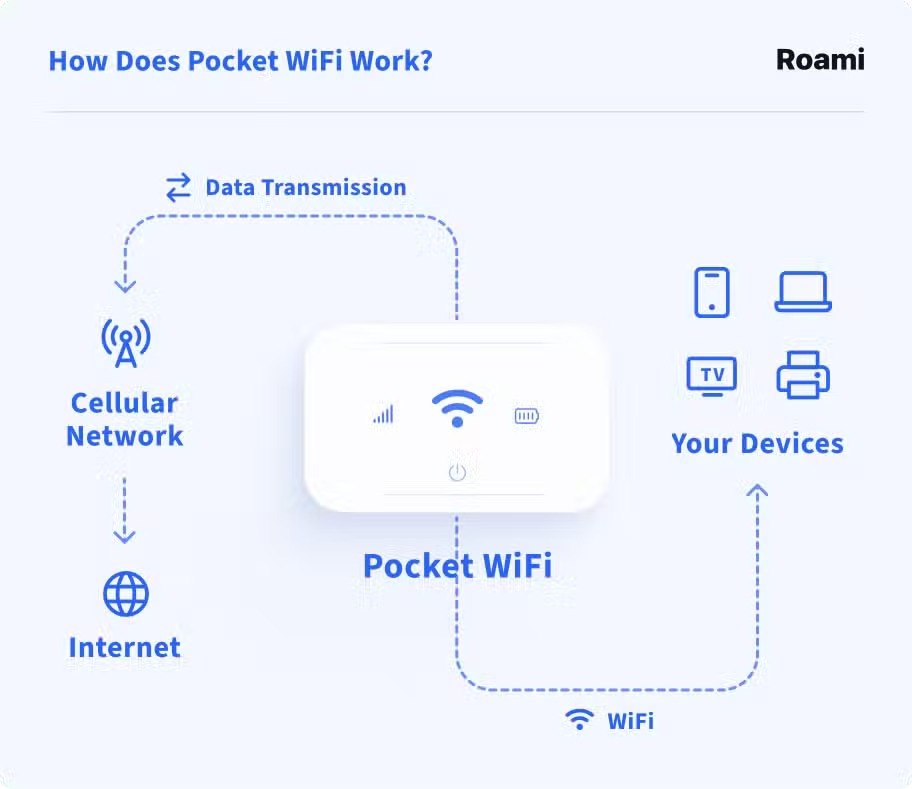
For travelers moving across Europe, pocket WiFi works as a single, reliable internet solution that travels with you. The device contains a SIM card that connects automatically to the strongest available mobile network in each country you visit.
It then creates a secure WiFi hotspot, allowing you to connect multiple devices by simply entering the password printed on the unit. Modern pocket WiFi devices usually support 4G and 5G connections, providing consistent speeds across borders.
Most models allow 5–10 devices to connect at once, which is convenient if you’re sharing with family or colleagues.
With a typical battery life of 8–12 hours, you can stay online throughout your journey whether you’re on a train through France, walking the streets of Rome, or relaxing on a beach in Greece (without swapping SIM cards in every country).
After looking at the current market, here are six leading pocket WiFi rental providers for Europe.
Hippocket WiFi provides unlimited 4G/5G data, though a fair use policy applies, so if you’re streaming or downloading heavily, speeds may be reduced after a threshold.
For normal use (maps, messaging, video calls, social media), the service is fast and reliable. Each unit can connect up to 10 devices at once, which is perfect for families, groups of friends, or business trips.
The battery lasts for a full day of sightseeing before you’ll need to recharge. Pricing is from €3.95/day, making it one of the more affordable multi-country options.
Delivery is flexible: you can receive the device at your home before departure or have it waiting at your hotel, apartment, or even at the airport when you arrive. Returns are simple too, with prepaid shipping envelopes included.
The main downside is that, like most rentals, you’re responsible for the unit if it’s lost or damaged. And while “unlimited” is advertised, heavy users should be aware of possible speed throttling.
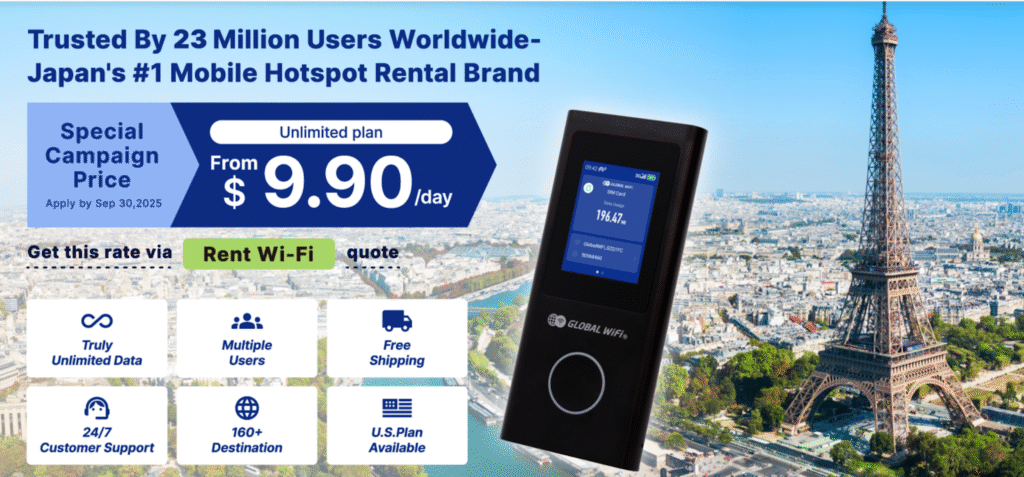
For Europe, Global WiFi offers two main options: a truly unlimited 5G/4G plan at $11.90 per day, or a lighter 1GB/day plan at $6.90. The unlimited package is particularly attractive because it comes with no throttling.
Each device can connect up to 10 gadgets at once, making it a good fit for groups, families, or colleagues who want to share costs. Battery life averages around 10 hours, enough to cover a full day of use before recharging.
Coverage is another strength. Global WiFi partners with multiple carriers in each country and automatically switches between networks to keep you on the strongest signal. In Europe, that includes more than 40 destinations from Spain and France to Norway, Greece, and Switzerland.
Delivery and return are straightforward. You can pick up the hotspot in major cities like New York before you depart, have it shipped to your home, or arrange delivery to your hotel. Returns are easy with prepaid kits.
However, the pricing is on the higher side compared to smaller regional providers, especially if you’re only staying in one country. And at nearly $12 per day, costs can add up fast on long trips.
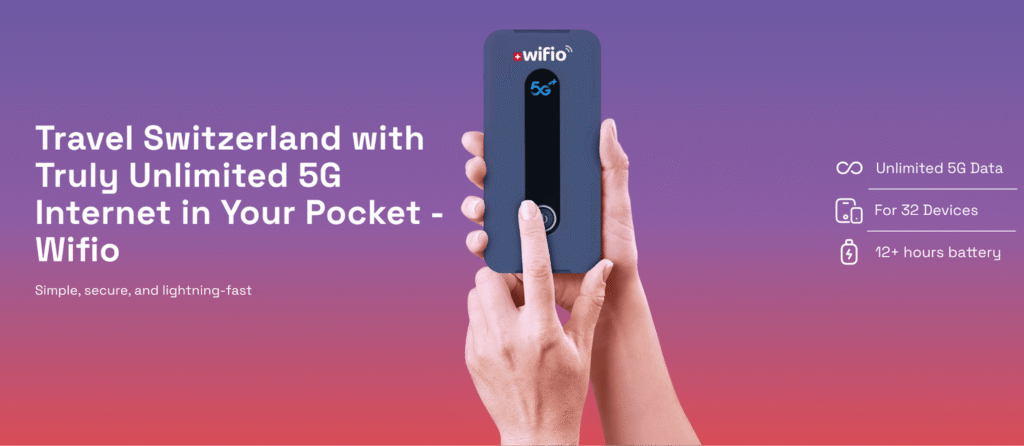
Wifio is a Swiss-based provider that markets itself as a premium pocket WiFi service with truly unlimited 5G data. Unlike many competitors, their routers can connect up to 32 devices at once.
Battery life is another strong point: each unit lasts over 12 hours on a single charge, so you can get through a full day without worrying about recharging.
Pricing is competitive if you’re staying longer, starting at just €2.25 per day for extended rentals. Delivery and pickup are flexible: you can collect a device at major hubs like Zurich or Geneva Airport, or choose from over 1,500 Swiss post office locations.
Coverage is strongest in Switzerland, but with the optional “Neighbors” add-on, you can extend service into Germany, France, Italy, Austria, and Liechtenstein. For travelers planning multi-country trips, Wifio also offers a Global Pocket WiFi option that ships worldwide and works in dozens of countries.
The main limitation is that coverage outside Switzerland requires selecting one of the expanded plans, and while the device supports unlimited 5G, speeds may vary depending on the local carrier.
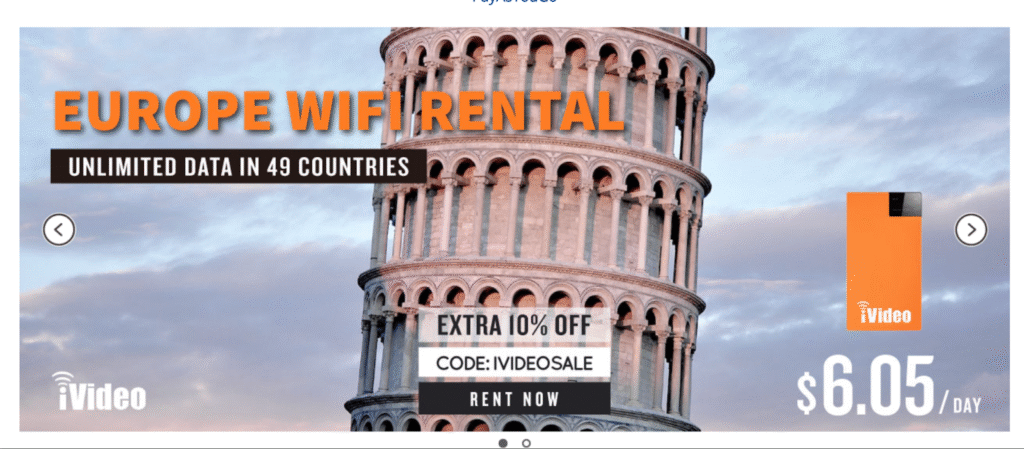
iVideo offers coverage across 49 European countries with unlimited 4G speeds, which makes it one of the widest regional options on the market. That means whether you’re sticking to Spain and France or adding in Eastern Europe, the same device will keep you online.
Pricing is very competitive: during frequent promotions, the Europe Unlimited plan drops to just $6.05/day, down from the standard $11/day. Longer monthly options are also available at $127, which works out well for extended stays.
Each hotspot supports up to 10 devices at once and lasts a full day on a single charge, making it easy to share between family members or friends without juggling multiple SIM cards.
Delivery is flexible: you can have the unit shipped internationally to your home or hotel before departure, or arrange local pickup in select regions like Japan, the U.S., and Taiwan.
The trade-offs are that customer support can feel slower compared to premium providers, and while speeds are reliable in major cities, rural areas may vary depending on the local carrier.
The Netgear Nighthawk isn’t a rental service, it’s a premium unlocked hotspot you buy outright. It’s designed for heavy data users who want full control over their connectivity while traveling in Europe (or beyond).
With cutting-edge 5G mmWave and WiFi 6E support, it can deliver speeds up to an astonishing 8 Gbps, far beyond what most rental devices offer.
One of its biggest strengths is flexibility: it’s unlocked and works with SIM cards from over 125 countries, including all the major European carriers. That means you can walk into a shop in Paris, Rome, or Berlin, and instantly have secure, high-speed internet.
Each unit supports up to 32 devices, lasts around 13 hours on battery, and can even double as a reliable home or office backup connection with coverage up to 2,000 sq. ft. when plugged in.
The catch? Price. At around $699.99 (sometimes discounted from $1,054.98), it’s a serious investment compared to renting a pocket WiFi for a short trip. But for digital nomads, long-term expats, it might be well-worth the investment.
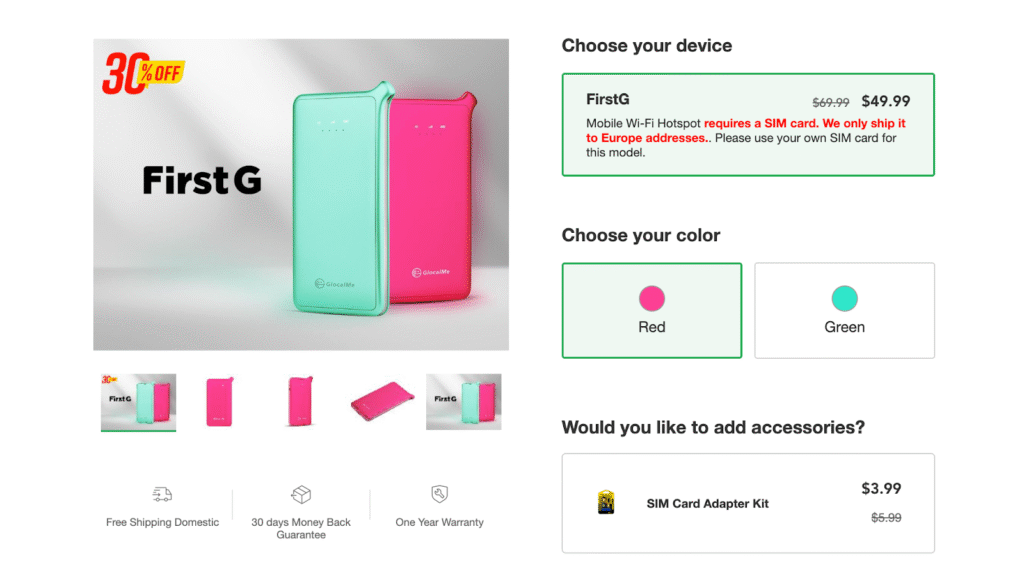
FirstG isn’t a rental, it’s a buy-once portable hotspot you own outright for around $49.99. Just insert any local SIM card, and you’ve got secure 4G LTE internet on the go. That makes it a smart, cost-saving alternative to daily rentals, especially for frequent travelers.
The device supports up to 8 devices, runs for about 14 hours per charge, and delivers speeds up to 150 Mbps. Because it’s fully unlocked, it works across Europe with carriers like Orange, Vodafone, and TIM.
At just 149 g, it’s lightweight, pocket-sized, and easy to set up. You can even manage data use or customize your network through its built-in web portal.
The catch: unlike rental hotspots or eSIMs, you’ll need to buy and manage SIM cards in each country. That means extra steps (like finding and activating local data plans) which won’t suit travelers who want a fully plug-and-play solution.
Here's a comparison of the top pocket WiFi in Europe to help you choose the best option for your needs:
| Provider | Price | Data | Devices supported | Advantage | Downside |
| Hippocket WiFi | €3.95/day | Unlimited (Fair use) | 10 | Affordable multi-country option | Speed throttling with heavy use |
| Global WiFi | $6.90–$11.90/day | 1GB–Unlimited (Fair use) | 10 | Seamless network switching | Expensive for single-country use |
| Wifio | €2.25/day | Unlimited 5G (Fair use) | 32 | Competitive pricing for longer stays | Limited coverage outside Switzerland without add-ons |
| iVideo | $6.05–$11/day | Unlimited 4G (Fair use) | 10 | Affordable rates, wide coverage | Slower customer support, rural coverage varies |
| Netgear Nighthawk | $699.99 (one-time purchase) | 5G | 32 | Blazing 5G speeds, flexible SIM use | High upfront cost, best for long-term users |
| FirstG (GlocalMe) | $49.99 (buy-once) | 4G LTE | 8 | Cost-effective, flexible for frequent travelers | Need to manage own SIM cards in each country |
Traveling across Europe often means juggling different SIM cards and roaming rules, and pocket WiFi provides one device that keeps you connected across borders, though often at a higher price than regional eSIMs.
If carrying an extra router doesn’t fit your travel style, an eSIM is the smartest alternative. With an eSIM, you connect directly to Europe’s top 4G and 5G networks. Just scan a QR code, activate your plan, and you’re online the moment your plane lands.

Holafly is the premium choice for travelers who want unlimited data with zero setup hassle. Their Europe eSIMs are especially popular with tourists who move between countries and need constant, high-speed access plus 24/7 support.
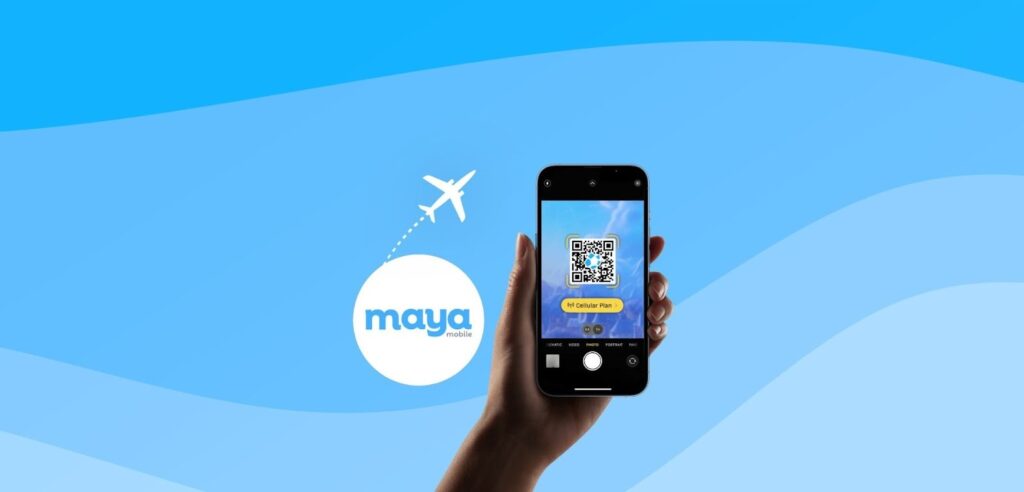
Maya Mobile is a flexible option that offers both large bundles and unlimited plans. It’s especially useful for travelers covering multiple countries across Europe, thanks to its wide coverage and fast 5G support.
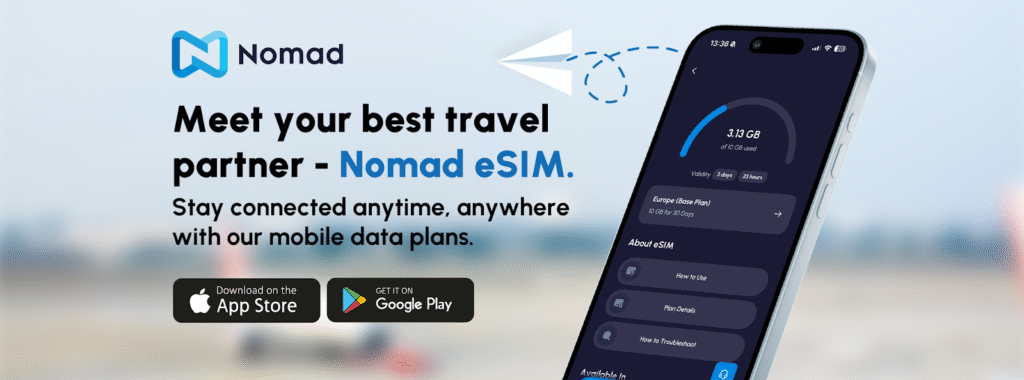
Nomad is built for flexibility. With transparent prepaid plans, high-speed 4G/5G, and automatic multi-country coverage, it’s one of the easiest ways to stay connected across the continent.
To make things simple, here’s a side-by-side look at the leading eSIM options for Europe:
| Provider | Price from | Data model | Best for |
| Holafly | $3.90/day | Unlimited (5–90 days) | Tourists who want unlimited data + easy setup |
| Maya Mobile | $5.99 (5 GB) | Bundles (5–100 GB) + Unlimited daily | Heavy users, streamers, or remote workers |
| Nomad | $5.50 (1 GB / 7 days) | Bundles (1–50 GB) | Flexible travelers, budget-friendly, multi-country trips |
If you mostly use maps, messaging, and light browsing, 5–10 GB should be enough. For streaming, social media, and video calls, aim for 15–20 GB. More is always safer if you don’t want to worry.
Yes, $3000 is usually more than enough for flights, stays, meals, and activities in most European countries. Your style of travel will decide how far it goes. Expect higher costs in cities like Paris, London, or Zurich.
Orange, Vodafone, and Three are popular choices with wide coverage. Many offer traveler-friendly prepaid SIMs. The “best” depends on your destination country, but these brands are reliable.
About 10–15 hours of HD streaming, or 30–40 hours in standard definition. Ultra-HD (4K) eats data much faster, around 7 GB per 2 hours. Always lower the streaming quality if data is limited.
Yes, it works perfectly as long as the device is on and connected. For extra security, download offline maps in case the WiFi cuts out. That way, you’ll never get stuck.
Most devices last 6–12 hours on a full charge. Heavy use drains it faster, especially if many people are connected. Carrying a power bank is highly recommended.
Local SIM cards, eSIMs, and international roaming are the main alternatives. Free WiFi hotspots in hotels, cafes, or airports also help, though less reliable.

Our mission is simple: to make sure you never have to ask, “What’s the WiFi password?” again. All our tips come straight from personal experience — because we’d never recommend something we haven’t put to the test ourselves.
Reviews