


Roaming
I've traveled across Alexandria and the Sinai, and I'm going to save you from making the same expensive mistakes I did. Roaming in Egypt works, but if you don't set things up right before you land, you'll be paying way more than you should. I've tested everything so you don't have to, and I'm sharing it all right here.


Here's what you need to know first: Egypt sits completely outside every roaming agreement out there. It doesn't matter if you're flying in from London, Paris, New York, or Toronto, everyone pays international rates unless they've planned ahead.
The good news? Planning ahead is easy, and I'll walk you through exactly how to do it.
Roaming is what happens when your phone connects to a local Egyptian network instead of your home carrier. The moment you land in Cairo and flip off airplane mode, your device starts scanning for signal.
If your carrier has agreements with Egyptian operators, you're connected automatically. That automatic part is also what makes it ‘dangerous’, charges start the second you connect, whether or not you meant for them to.
Egypt's four main mobile networks are Vodafone Egypt, Orange Egypt, e& (formerly Etisalat Egypt), and WE (Telecom Egypt). 4G LTE is solid throughout Cairo, Alexandria, and major tourist destinations like Sharm el-Sheikh, Hurghada, Luxor, and Aswan.

You'll notice the network thin out in the Western Desert and very remote Upper Egypt areas, but anywhere you're likely to spend real time as a traveler is well covered.
One important thing to know upfront: Egypt is not an EU member state, not part of the EEA, and has no bilateral roaming agreements that would make it affordable by default. This applies to everyone - European travelers don't get Roam Like at Home here.
American, Canadian, British, and European travelers are all in the same boat: you're paying international roaming rates unless you've set something else up in advance.
AT&T
AT&T's International Day Pass covers Egypt at $12/day and lets you use your existing plan's data, calls, and texts while you're there. It only charges on days you actually use your phone, which is a nice touch.
Without it, AT&T's pay-as-you-go rate hits $2.05/MB, that's over $2,000 per GB. Activate the pass before you board. Prepaid AT&T customers can look at the Travel Add-On at $35/week, which includes 5GB of data.
Verizon
Verizon's TravelPass also runs $12/day in Egypt, covering unlimited talk, text, and up to 2GB of high-speed data before throttling to slower speeds. Egypt falls under their standard international zone.
Without the pass, you're looking at the same $2.05/MB pay-per-use rate as AT&T. Their monthly international plan exists but caps data low enough that it rarely makes sense for Egypt travel specifically.
T-Mobile
T-Mobile is again the most generous US option. Go5G Next and Experience Beyond customers get up to 15GB of free high-speed international data in Egypt, then unlimited at reduced speeds. Calls are $0.25/minute, but most travelers just use WhatsApp anyway.
On Go5G Plus or Magenta MAX, you get 5GB before throttling. If you need more, T-Mobile's 30-Day International Pass with 15GB runs $50, which is significantly better value than daily passes from the other two.
Rogers Rogers's Roam Like Home service covers Egypt at $15/day, mirroring your Canadian plan while you travel. For trips longer than a few days, Travel Passes for 7, 14, or 30 days reduce the per-day cost.
Without any pass activated, pay-per-use can climb into the hundreds of dollars very quickly, so always set something up before departure.
Bell
Bell's Roam Better service charges $16/day for Egypt. Their global roaming plan at around $70+/month covers Egypt among roughly 78 countries, with data capped at 10GB while roaming internationally, which I find decent for frequent international travelers.
Pay-per-use without any pass is expensive enough that even a few hours of casual browsing can generate a nasty bill.
Telus
Telus is the priciest of Canada's Big Three for Egypt, at $18/day through Easy Roam. Their premium plans (5G+ Complete Explore) include Egypt among supported destinations for around $95–100/month, which only makes sense if you're a heavy international traveler going multiple times a year.
Pay-per-use without Easy Roam activated runs $5–10/MB, genuinely one of the most expensive rates you'll find. Always activate Easy Roam before your phone touches Egyptian airspace.
Egypt is firmly outside the EU roaming zone, and Brexit is irrelevant here, even before Brexit, Egypt wasn't covered. UK travelers are paying international rates across all carriers.
EE
Egypt is not part of EE's European Roam Abroad zone. For Egypt, EE's standard international rates apply, typically a £6/day add-on through their International Travel Pass, or pay-as-you-go at up to £8/MB without one.
Always check your exact plan and activate a pass before landing, one day of unmanaged browsing can cost more than your hotel.
O2
O2's EU roaming benefit doesn't extend to Egypt. For Egyptian travel, O2 offers data bolt-ons and international day passes, but Egypt falls under their wider international zone rather than any preferential rate.
Check O2's current international rates before you fly, as pricing changes and depends on your specific plan.
Three
Three's Go Roam benefit covers a number of destinations, but Egypt is not included. You'll need to purchase an international add-on or pay daily data rates. Three offers international data day passes for destinations outside Go Roam, so check the current offer in your account before departure.
Vodafone
Egypt sits in Vodafone's international (non-EU) roaming zone. Vodafone offers travel passes for Egypt, typically around £5–8/day depending on your plan, or pay-as-you-go at rates that can exceed £7/MB.
If you're on an Xtra plan, check whether any international credit or pass is included. It's worth adding a pass through the app before you fly.
Lebara
Lebara runs on Vodafone's UK network but its roaming agreements for non-EU destinations like Egypt vary by plan and can be more limited. Check your specific tariff before assuming coverage since Egypt may require a separate international bolt-on or may not be supported at all.
Unlike traveling within the EU or EEA, Egypt gives no one a free ride. The Roam Like at Home regulation only applies between EU member states. Once you cross into Egypt, you pay your carrier's standard international rates for calls, texts, and data.
Most EU carriers offer international day passes or global roaming add-ons that cover Egypt, typically ranging from €3–€10/day depending on the operator and plan. French, German, Italian, and other EU travelers should check with their carrier and activate a pass before landing.
And if you're still planning the trip itself, here's exactly how much Egypt costs (spoiler: it's more affordable than you think!).
After a couple of trips where roaming bills surprised me, eSIMs became my default setup for Egypt. You buy a plan before you leave, install it on your phone, and activate it the moment you land.
Your home SIM stays live for calls and messages; the eSIM handles your data. No queuing at an airport kiosk, no digging through your settings mid-arrival.
Here are three providers that work well in Egypt:
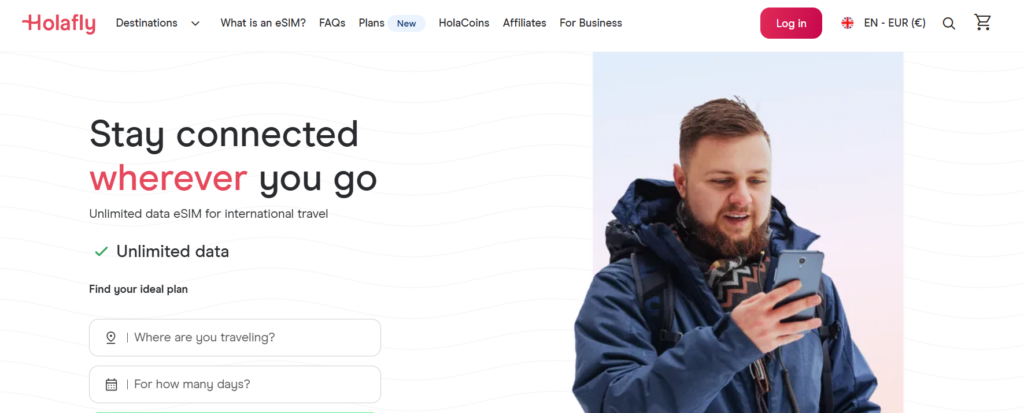
Holafly sells unlimited data plans only, which takes all the guesswork out of it. For Egypt, plans start around $36.90 for 7 days, dropping to better value on longer options. It connects to local Egyptian networks with solid 4G LTE performance across Cairo, Hurghada, and Sharm el-Sheikh.
Hotspot tethering is capped at 500MB/day, so it's not ideal if you want to share data with a laptop or second device. Keep in mind that no phone number is included, it's data-only. Holafly works with most recent iPhones and Android flagships.

Airalo offers Egypt plans starting from around $14.50 for 3GB valid for 7 days, scaling up to larger packages like 20GB for $49. It's flexible, and the tiered options make it easy to match your usage without overpaying.
There’s no daily tethering cap, which is helpful if you're sharing with a travel companion. This one is also data-only, with no local number included. The Airalo app is straightforward on both iOS and Android, and customer support is responsive if setup doesn't go smoothly.

Saily is a solid option for Egypt, with plans starting around $5.99 for 1GB over 7 days. It's best suited for people who mostly rely on hotel WiFi and just want a reliable connection. Setup is clean, coverage runs on 4G LTE, and there are no surprise fees. It’s compatible with most modern eSIM-capable devices.
There's no universal right answer. It depends on how long you're staying, how much data you actually use, and how much effort you want to put in before the trip.

An eSIM installs directly on your phone, which means that once scan a QR code, the plan loads, and you activate it when you land. Your original SIM stays active for calls and texts from home. It's by far the most convenient option and typically much cheaper than carrier roaming passes.
We've tested several providers head-to-head and here's the best eSIM for Egypt based on real usage.
Egyptian prepaid SIMs from Vodafone Egypt, Orange Egypt, or e& are excellent value, typically EGP 50–150 (roughly $1–3 USD) for several gigabytes of data. You'll find them at Cairo Airport, phone shops, and some supermarkets.
You'll need your passport to register, and you'll get an Egyptian number, meaning your regular SIM won't receive calls while it's inactive. For longer trips or anyone on a tight budget, a local SIM is hard to beat on pure cost.
Still deciding which network to go with? This SIM card comparison for Egypt breaks it all down by price and coverage.
Portable WiFi devices rent for around $5–10/day in Egypt and connect multiple devices at once. It's a practical option for groups or anyone traveling with a laptop and a phone. The downside is an extra device to carry and charge. Some hotels can help arrange rental.
Thinking about renting a device? Here's everything you need to know about Pocket WiFi in Egypt.
Cairo and the major resort towns have reasonable public WiFi in cafés, hotel lobbies, malls, and restaurants. If you download Google Maps offline before you arrive and you're mostly in built-up areas, free WiFi can carry a lot of the load on a short trip. It's not reliable enough for constant navigation, but as a complement to a small eSIM plan, it works.
| Option | Typical price | Convenience | Best for |
| eSIM | From ~$4.50 for 1GB / ~$36 for unlimited 7 days | Very high (set up before you fly) | Most travelers, flexible trips |
| Local SIM | EGP 50–150 (~$1–3 USD) for several GB | Medium (need passport, visit a store) | Budget travelers, longer stays |
| Pocket WiFi | ~$5–10/day rental | Medium (extra device to carry and charge) | Groups, multiple devices |
| Free WiFi | Free | Low (unreliable, not always secure) | Light users, short stays |
Not sure which option suits your trip? Here's how to get mobile internet in Egypt - all options compared in one place.
Yes, roaming works in Egypt with most international carriers. The catch is that Egypt sits outside every roaming agreement, EU, UK, everyone pays international rates. Set up a day pass or eSIM before you fly, or you'll be hit with brutal pay-as-you-go fees.
An eSIM is the sweet spot for most travelers because it’s cheap, easy, and you get to keep your home number active. If you're staying longer or on a tight budget, a local SIM from Vodafone Egypt or Orange runs just $1–3 for several GB.
WhatsApp works great in Egypt as long as you have data. Worth noting though - voice and video calls can be hit or miss, sometimes they connect fine, other times they don't go through at all, so don't count on them for anything important.
Most likely yes. Egypt has four major networks (Vodafone Egypt, Orange Egypt, e&, and WE), and most international carriers have agreements with at least one of them.
The easiest move is grabbing an eSIM before you leave home. Plans start around $4.50 for 1GB. Local SIMs are even cheaper if you don't mind a quick stop at a shop with your passport. Free WiFi in hotels and cafés can cover the gaps if you're not a heavy data user.
Egypt requires passport registration when purchasing a local SIM card. It's a straightforward process at any phone shop or airport kiosk, you just need to have your passport on you.

Our mission is simple: to make sure you never have to ask, “What’s the WiFi password?” again. All our tips come straight from personal experience — because we’d never recommend something we haven’t put to the test ourselves.
Reviews