

SIM Cards
After comparing price, data, coverage, and activation, I found Vodafone Germany to be the best SIM card overall thanks to its strong value and larger data allowances. Local SIMs are usually cheaper than eSIMs, but getting one often means dealing with ID checks and extra setup after arrival.


I compared the main providers in Germany based on price, data, validity, and coverage, along with how easy they are to buy at the airport versus in the city. While local SIMs offer better value for data, they’re not always the fastest option to get up and running. For short trips especially, eSIMs often end up being the more practical choice since you can set everything up in advance and get online right away.
Quick verdict: If you expect to use heavy data, Vodafone Germany is the best overall choice thanks to higher data allowances for similar prices, while Deutsche Telekom is better if you prioritize coverage and reliability across the country.
| Provider | Price (from) | Data | Validity | Network coverage in Germany | Where to buy | Best for |
| Deutsche Telekom | ~€9.95 (~$10.80) | 20GB | 4 weeks | Best overall coverage, especially rural areas | Official stores, online | Reliability and travel outside cities |
| Vodafone Germany | ~€9.99 (~$10.80) | 25GB | 4 weeks | Strong nationwide coverage, slightly behind Telekom | Stores, kiosks, online | Best value and heavy data users |
| Telefónica Germany | ~€9.99 (~$10.80) | 20GB | 4 weeks | Good in cities, weaker in rural areas | Online, stores, delivery | Budget and city use |
SIM cards in Germany typically start at around €10 (~$10.80) for prepaid plans with moderate data, with higher data bundles costing more depending on usage.
If you want convenience, buying at the airport is easiest but often more expensive, while city stores usually offer better value and more plan options.
Pro tip: Airports usually have travel stores where you can also pick up plug adapters, as Germany uses Type C and Type F plugs, so it’s easy to grab one when you arrive if needed.
For short trips, a 20 to 30GB plan is usually enough, but heavy users may benefit from higher data or unlimited plans. If you plan to travel outside major cities, Deutsche Telekom is the most reliable choice, while Vodafone Germany offers better value for data and Telefónica Germany works well for budget travelers staying mostly in urban areas.

Germany’s top mobile networks offer a mix of strong coverage, competitive pricing, and flexible prepaid options for travelers.
Deutsche Telekom is known for the most reliable coverage across the country, especially outside major cities, while Vodafone Germany offers better value with higher data allowances at similar prices.
Telefónica Germany is typically the cheapest option, though coverage can be slightly less consistent in rural areas.
Note: Prepaid bundles, pricing, and data allowances can change, so it’s best to confirm the latest offers in-store or on each provider’s official website before purchasing.
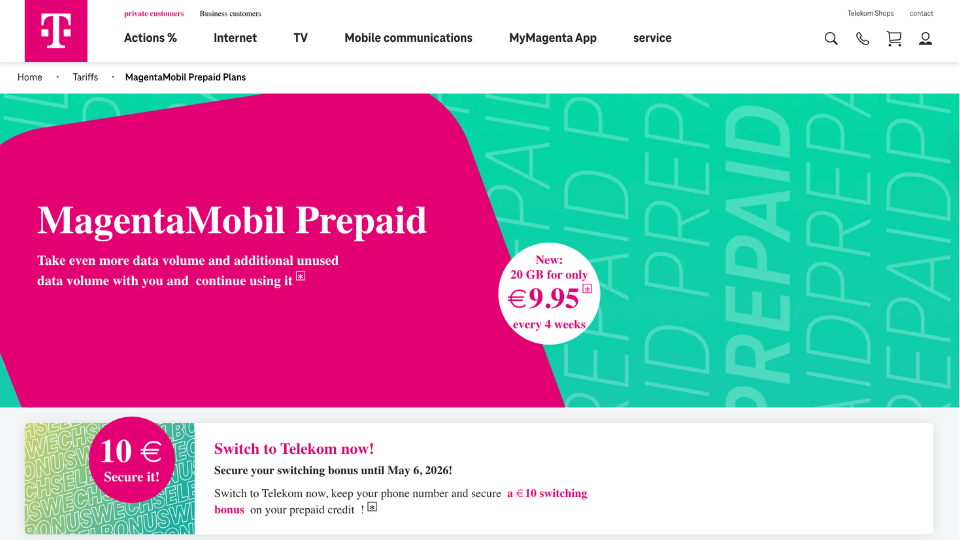
Deutsche Telekom offers prepaid plans under its MagentaMobil lineup, known for strong network coverage and fast 4G and 5G speeds across Germany. Its prepaid options include generous data allowances, unlimited calls and texts within Germany, and EU roaming at no extra cost, making it a reliable choice for travelers who want consistent performance.
Plans & pricing:
| Duration | Data | Price | Notes |
| 4 weeks | 20GB | €9.95 (~$10.80) | Unlimited calls/texts in Germany |
| 4 weeks | 40GB | €14.95 (~$16.20) | Data rollover included |
| 4 weeks | 80GB | €19.95 (~$21.60) | Higher data plan |
| 4 weeks | Unlimited | €99.95 (~$108) | Full unlimited plan |
Quick verdict:
Best for travelers who want the most reliable network and strong coverage across Germany. Available through Telekom stores and online, though activation requires ID verification and setup can take slightly more effort.
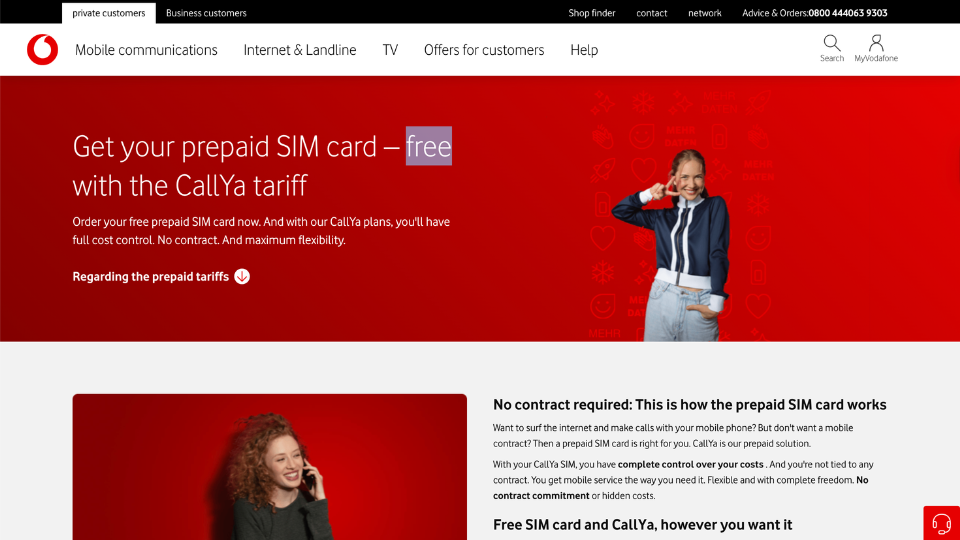
Vodafone offers prepaid SIM cards under its CallYa lineup, with no contract, full cost control, and flexible top-up options. Plans include data bundles with unlimited calls and texts within Germany, plus EU roaming at no extra cost, making it a practical option for travelers who want flexibility without long-term commitments.
Plans & pricing:
| Duration | Data | Price | Notes |
| 4 weeks | 25GB | €9.99 (~$10.80) | Unlimited calls/texts in Germany |
| 4 weeks | 50GB | €14.99 (~$16.20) | Includes EU roaming |
| 4 weeks | 100GB | €19.99 (~$21.60) | Higher data plan |
| 4 weeks | Unlimited | €79.99 (~$86.50) | Full unlimited plan |
Quick verdict:
Best for travelers who want flexible prepaid options with strong data allowances and no contract. Available as a free SIM card through Vodafone stores or online, but you’ll need to top up credit to use it, and activation requires ID verification which can take extra steps compared to eSIMs.
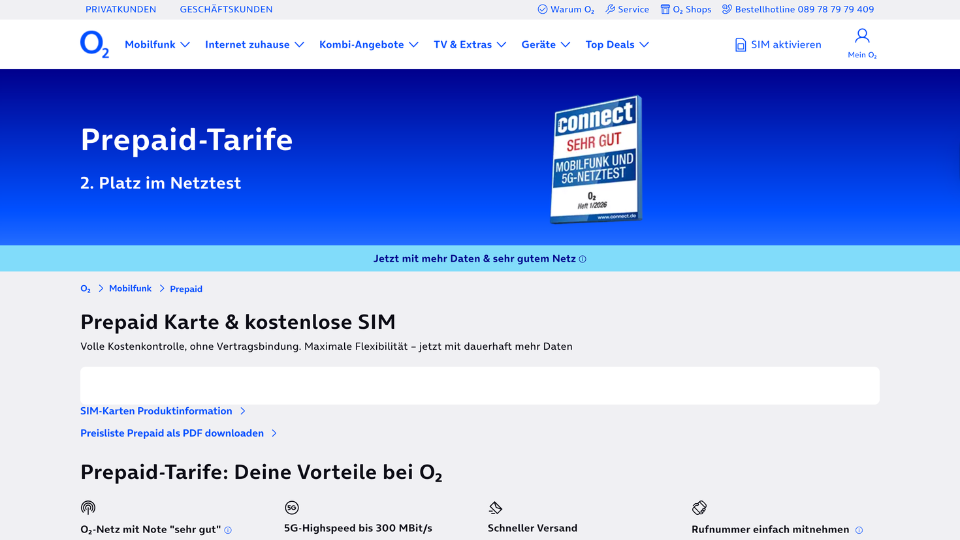
O2 offers prepaid SIM cards with no contract, full cost control, and flexible top-up options. Its network covers around 99% of Germany and supports 5G speeds, with plans that include EU roaming and unlimited calls and texts within Germany, making it a strong budget-friendly option for travelers.
Plans & pricing:
| Duration | Data | Price | Notes |
| 4 weeks | 20GB | €9.99 (~$10.80) | Allnet flat, EU roaming included |
| 12 months | 150GB total | €89.99 (~$97) | Annual plan (~€7.50/month) |
| Pay-as-you-go | Varies | €0 (~$0) | No base fee, pay per use |
Quick verdict:
Best for budget-conscious travelers who want flexible prepaid plans with good data allowances. Available as a free SIM card with delivery in 2 to 4 days or via eSIM, though coverage may be slightly less consistent than Telekom in rural areas.

Getting a SIM card in Germany is straightforward, but in practice it can take more time than expected due to ID verification and activation steps. Many travelers assume it’s instant, but setting up a prepaid SIM usually involves a few extra steps before you’re fully connected.
From experience, getting connected in Germany can take more time than expected depending on the option you choose.
On past trips, I relied on pocket WiFi, but it meant carrying an extra device, keeping it charged, and managing another rental. Switching to eSIMs was much easier since everything can be set up before arrival and used instantly without extra hardware.
I’ve tested several eSIM options while traveling, including Holafly, Nomad eSIM, and Airalo, and they’ve consistently been more convenient for short trips.
Activation is quick, there’s no need to swap SIM cards, and you can get online as soon as you land, which makes them a practical alternative to both local SIMs and pocket WiFi.
| Provider | Price (from) | Data | Validity | Best for | |
| Holafly |  | $3.90 | Unlimited | 1 day | Heavy data users |
| Nomad |  | $4.50 | 1GB | 7 days | Light usage, budget |
| Airalo |  | $4 | 1GB | 3 days | Flexible low-cost data |
You can check full reviews and plan details for Holafly, Nomad eSIM, and Airalo to compare options based on your data needs and trip length.
Vodafone Germany is the best overall for value, offering more data for similar prices. Deutsche Telekom is best if you prioritize coverage and reliability, especially outside major cities.
A prepaid SIM card is the best option for most travelers since it offers flexibility with no contract. If you want the easiest setup, an eSIM is often more convenient than a physical SIM.
You can buy a SIM card at airports, kiosks, supermarkets, or official provider stores across Germany. After purchase, you’ll need to complete identity verification online or in-store before activation.
Most useful prepaid SIM plans start at around €10 (~$10.80) for 20–25GB of data valid for about 4 weeks. Higher data or unlimited plans cost more depending on the provider and usage.
You need a valid ID such as a passport or national ID card to register and activate a SIM card. Verification is typically done online via selfie or video identification before the SIM becomes active.

Our mission is simple: to make sure you never have to ask, “What’s the WiFi password?” again. All our tips come straight from personal experience — because we’d never recommend something we haven’t put to the test ourselves.
Reviews