


Before my last trip to Poland, a friend reminded me that the country uses a different plug type, which turned out to be life-saving advice since Poland uses Type C and E plugs, unlike what I use in the US.
In this guide, I cover everything you need to know about plug types in Poland, including whether you’ll need a plug adapter or voltage converter, plus simple tips to stay connected while you’re there.
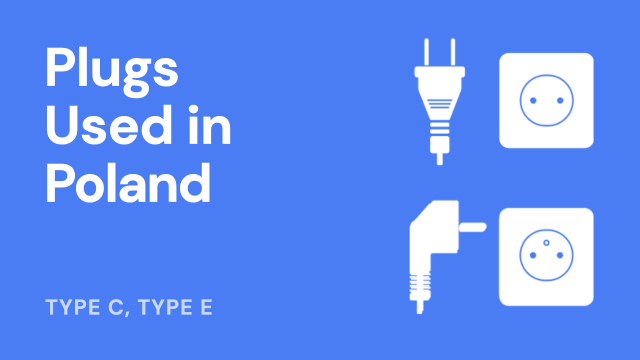
Poland uses Type C and Type E plugs, with a standard voltage of 230V and a frequency of 50Hz.
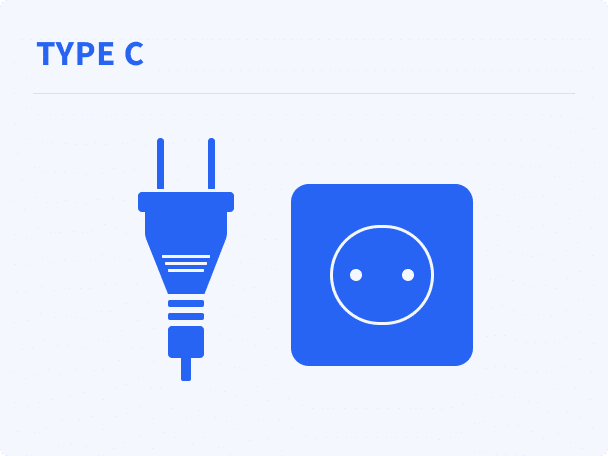
Plug Type C has two round pins and no grounding pin. It’s commonly used for low-power devices like phone chargers, laptops, and other small electronics that don’t require grounding.
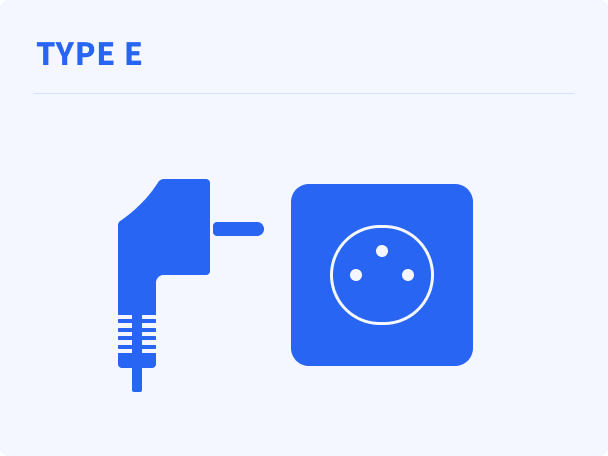
Plug Type E has two round pins with a hole for a grounding pin in the socket. It’s used for higher-power or grounded devices like kitchen appliances and larger electronics that need extra safety.
You can buy an adapter for Poland in major airport shops, electronics stores, and larger department stores. But it’d be best if you could have it before you get to Poland. Here’s where I got the adapters I used for my trip.
The TSA Universal US to Poland Travel Adapter is designed for Type C (European) outlets used in Poland. It features reinforced prongs, fireproof ABS plastic, and copper components rated up to 6 amps for durability and safety.
It’s available in two- and six-pack options and comes in black, blue, orange, white, and yellow.
The Tmvel 2-in-1 Europe Travel Adapter supports Type C, E, and F outlets, making it suitable for Poland and most of Europe. It features a grounded Schuko plug and an internal metal interface for improved conductivity and a stable connection.
The adapter comes with a lifetime limited warranty and is available in one-, two-, four-, and eight-pack options.
The SF Cable Australia to Europe Schuko Adapter converts an Australian Type I plug to a European Type E/F (Schuko CEE 7) plug, making it suitable for use in Poland and across Europe. It supports three-prong grounded connections and is rated up to 10A, 250V for reliable performance.
It depends on your device’s voltage rating. Poland uses 230V at 50Hz, which is higher than the 120V used in countries like the US and Canada, but the same as the UK, most of Europe, and Australia. Because of this, whether you need a converter comes down to whether your device can handle a wide voltage range.
There are about four ways to get internet in Poland: roaming, eSIM, SIM card, and pocket WiFi.
Roaming lets you use your existing mobile plan outside your home country. Providers like Verizon and AT&T offer travel passes (around $12 per day) that include data, calls, and texts. Data roaming is a convenient option, but it can get expensive for longer stays.
If your phone supports eSIM, you can buy an eSIM for Poland, set up a plan online before your trip, and activate it when you arrive. Providers like Holafly offer unlimited data, while Orange Travel includes data, calls, and texts.
You can buy a prepaid SIM card for Poland from local providers like Play, Plus, Orange, or T-Mobile. These plans often include calls, texts, and data, with some offering unlimited options. You’ll usually need your passport, and your phone must be unlocked to get and use a SIM card.
Pocket WiFi is a portable device that provides internet for multiple devices. Providers like My Webspot and MioWiFi offer rentals for Poland with long battery life (up to 18 hours).
You can either have it delivered to your accommodation or your current residence, or pick it up at the airport or a store.
If you’re traveling to other countries, check which plug type your destination uses below. See how the plug types look in the image after the table.
| Plug Type | Destinations |
| Type A | US, Canada, Mexico, Japan |
| Type B | US, Canada, Honduras |
| Type C | South Korea, Germany, Italy, Spain, Thailand, Iceland |
| Type D | India, Nepal |
| Type E | France, Belgium, Poland |
| Type F | Georgia, Germany, Netherlands, Spain, Indonesia |
| Type G | UK, Cyprus, Singapore, Hong Kong, Ireland |
| Type H | Israel |
| Type I | Australia, New Zealand, China |
| Type J | Switzerland |
| Type K | Denmark |
| Type L | Italy |
| Type M | South Africa |
| Type N | Brazil |
| Type O | Thailand |
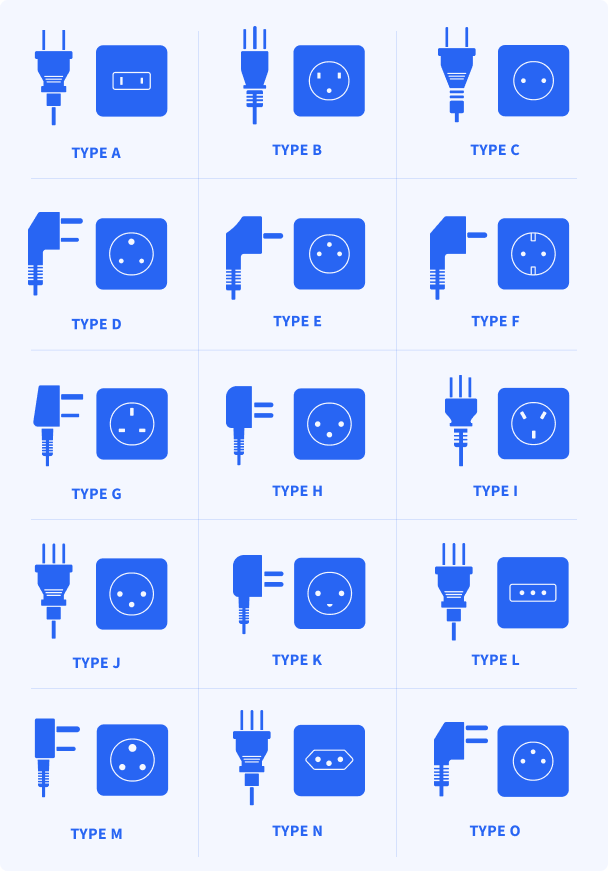
Poland uses Type C and Type E plugs, both with two round pins. Type C is the standard two-pin plug used for most small electronics, while Type E includes a grounding hole for added safety. If your device uses a different plug shape, you will need an adapter that converts it to either Type C or Type E.
Yes, Poland follows the standard European plug system and uses Type C and Type E plugs, which are common across many countries in mainland Europe. Most adapters labeled for Europe will work in Poland.
Krakow uses the same plug types as the rest of Poland, which are Type C and Type E. There are no regional differences, so one adapter will work throughout the country.
Yes, Type C plugs are compatible with most outlets in Poland and are widely used for everyday devices like phone chargers and laptops. However, for devices that require grounding, a Type E connection is more suitable.
Yes, you will need a different plug adapter because the US uses flat-pin plugs, while Poland uses round-pin Type C and Type E plugs. Poland also operates on 230V, so you should check that your device supports this voltage.
No, Poland does not use the same plugs as the UK. The UK uses a three-pin rectangular plug system, while Poland uses Type C and Type E plugs, so an adapter is required.
No, Canada uses flat-pin plugs similar to the US, whereas Poland uses Type C and Type E plugs with round pins. Travelers from Canada will need an adapter to use their devices in Poland.
No, Australia uses a different plug type with angled flat pins, while Poland uses Type C and Type E plugs with round pins. An adapter is needed, although the voltage is similar, so most devices will still work without a converter.

The best global eSIM provider
From $2.3/week
A reliable eSIM provider for budget travelers
From $2.4/week
The best global eSIM provider
From $2.3/week
A reliable eSIM provider for budget travelers
From $2.4/week
Our mission is simple: to make sure you never have to ask, “What’s the WiFi password?” again. All our tips come straight from personal experience — because we’d never recommend something we haven’t put to the test ourselves.
Reviews