
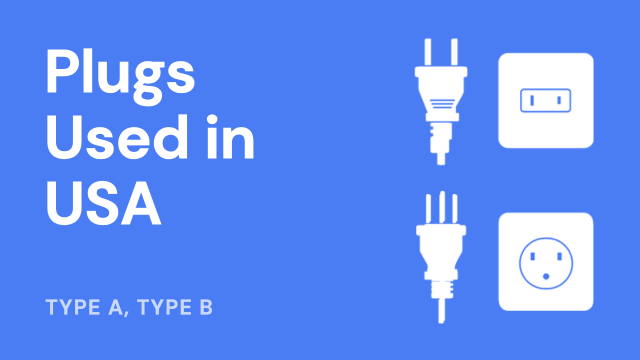


If you’re planning a trip to the United States, it’s worth knowing that the country uses Type A and Type B plugs, with a standard voltage of 120V at 60Hz. Travelers from Canada typically won’t need an adapter, but those coming from Europe, the UK, or Australia will.
In this guide, I’ll walk you through everything you need to know about US plug types, what they look like, which adapter you’ll need, where to buy one, and a few practical tips to stay connected while you’re there.
The US uses Type A and B plugs with a standard voltage of 120V and a frequency of 60Hz. The plug type you’ll need depends on your device.
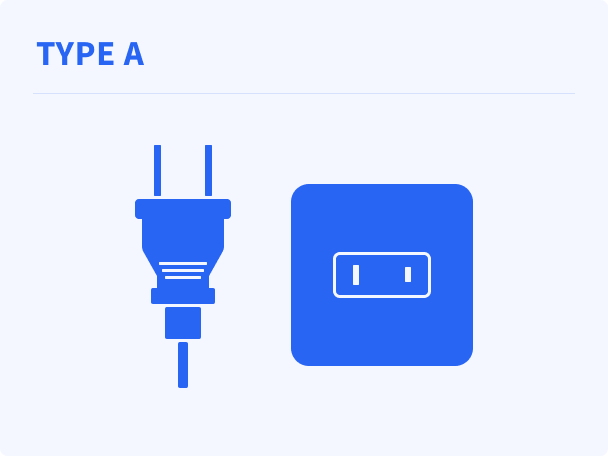
Type A plugs have two flat, parallel pins and no grounding pin, making them compact and lightweight. They’re typically used for low-power devices like phone chargers, laptops, and other small electronics that don’t require grounding.
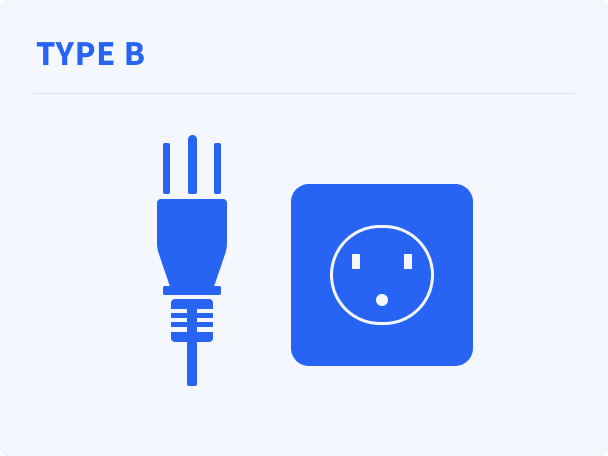
Type B plugs have two flat parallel pins plus a round grounding pin, forming a three-prong design. They’re used for higher-power or grounded devices such as kitchen appliances, desktop computers, and equipment that needs extra safety through grounding.
You can buy a US plug adapter online from websites like Amazon or Tesco, or in-store at supermarkets, electronics shops, and travel stores. Airports sell them too, but usually at higher prices. Below are some brands I’ve personally recommended to friends visiting the US.
The EPICKA Universal Travel Adapter includes four built-in plug types that cover over 200 countries and regions. It features a 10A fuse, safety shutters, and a plug lock system for added protection, available in grey, blue, rose gold, black, and white, and comes with a 30-day money-back guarantee plus free replacement if there are any issues.
The Ceptics GP Series Adapter Set includes five plug types: Type B (US, Canada, Japan), Type G (UK, Dubai, Hong Kong), Type C (Europe), Type E/F (Schuko), and Type I (Australia). Each adapter has a universal input, so you can use plugs from most countries, including three-prong devices. It comes in five-pack and 12-pack sets.
The Daffodil WAP150 supports Type A (US), C/E/F (EU), G (UK), and I (AU) plugs. It uses a push-and-slide mechanism to switch between plug types, including straight and angled flat pins for US and Australia, and a two-pin EU plug. It has a compact, all-in-one design suitable for multi-country use.
It depends on your device. The US uses 120V, which is lower than the 220–240V used in many countries.
If your device supports 100–240V, which is common for phones, laptops, and chargers, you don’t need a voltage converter. For example, if you’re coming from the Philippines, the UK, or Europe, most of your everyday electronics will work fine.
If your device is 220–240V only, you will need a voltage converter. This usually applies to high-power items like hair dryers, straighteners, or kettles. Keep in mind that using these kinds of devices without a voltage converter can damage them.
If you’re coming from countries like Canada or Japan, you typically don’t need a converter at all, since they use similar voltage.
You can stay connected in the US in four ways: roaming, eSIM, SIM card, and pocket WiFi.
Roaming in the US lets you use your current mobile plan while traveling. Many providers, such as Vodafone and Telus, offer travel passes or pay-as-you-go plans. Data roaming is convenient, but it can be expensive if you don’t have a travel plan in place.
If your phone is eSIM compatible, an eSIM for the USA is one of the easiest options. You can buy and activate a plan online before or after you arrive. Providers like Holafly offer unlimited data, while Airalo has more flexible, budget-friendly plans.
You can buy a physical SIM card from US providers like Verizon or T-Mobile. These prepaid plans usually include data, calls, and texts, and often don’t require contracts or credit checks. You can get them at airports or retail stores, but you’ll need to swap your SIM card.
A pocket WiFi for the US gives you a portable internet connection that multiple people can share. It’s a good option for families or longer trips. Providers like TravelWiFi and MIOWIFI offer rental plans based on your data needs and travel duration.
If you have other trips planned after your US visit, check what plug type your destination uses below. You can also refer to the image after the table to see what each plug looks like.
| Plug Type | Destinations |
| Type A | US, Canada, Mexico, Japan |
| Type B | US, Canada, Honduras |
| Type C | South Korea, Germany, Italy, Spain, Thailand, Iceland |
| Type D | India, Nepal |
| Type E | France, Belgium, Poland |
| Type F | Georgia, Germany, Netherlands, Spain, Indonesia |
| Type G | UK, Cyprus, Singapore, Hong Kong, Ireland |
| Type H | Israel |
| Type I | Australia, New Zealand, China |
| Type J | Switzerland |
| Type K | Denmark |
| Type L | Italy |
| Type M | South Africa |
| Type N | Brazil |
| Type O | Thailand |
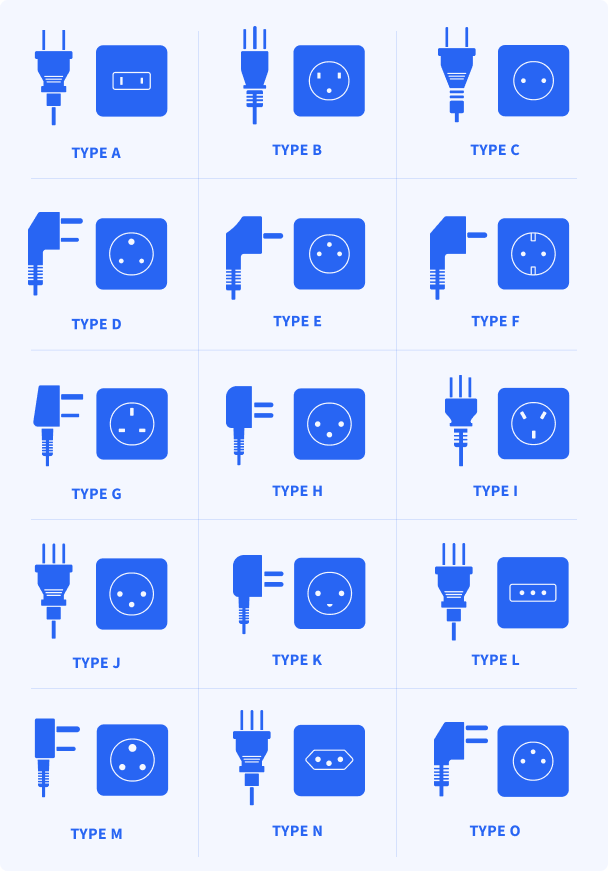
The US uses Type A and Type B plugs. Type A has two flat parallel pins, while Type B has two flat pins plus a round grounding pin. The standard voltage is 120V with a frequency of 60Hz.
US plugs are often two-pronged because many devices do not require grounding for safe operation. These plugs, known as Type A, are designed for low-power or double-insulated devices like phone chargers and small electronics. Devices that need extra safety use a third grounding pin (Type B).
Yes, the US operates on a voltage range of about 110V to 120V. Most outlets supply 120V, which is compatible with devices labeled for 110V. Electronics designed for this range will work normally.
If you plug a 220V-only appliance into a 110V outlet, it will usually not work properly or may run at reduced power. For example, heating devices may not heat up fully, and motors may not function correctly. It typically will not cause damage, but the device will not perform as intended.
No, the US does not use the same plugs as the UK. The UK uses Type G plugs with three rectangular pins, while the US uses Type A and Type B plugs with flat pins. An adapter is required when traveling between the two.
Yes, the US and Canada use the same plug types, Type A and Type B, and both countries operate on similar voltage systems (around 120V). Devices are generally fully compatible between the two.
No, Australia uses Type I plugs with angled flat pins, which are not compatible with US outlets. Travelers will need a plug adapter, and should also check voltage compatibility since Australia uses 230V.
To use a 220V appliance in the USA, you will need a voltage converter or transformer that steps up 120V to 220V. You may also need a plug adapter if the plug shape is different. It is important to check your device’s label, as some electronics support dual voltage and only require a plug adapter.

The best global eSIM provider
From $2.3/week
A reliable eSIM provider for budget travelers
From $2.4/week
The best global eSIM provider
From $2.3/week
A reliable eSIM provider for budget travelers
From $2.4/week
Our mission is simple: to make sure you never have to ask, “What’s the WiFi password?” again. All our tips come straight from personal experience — because we’d never recommend something we haven’t put to the test ourselves.
Reviews