


Mobile Internet
Mobile internet in Rome is easy to get through eSIMs, local SIM cards, roaming, or pocket WiFi. After comparing the options, I found eSIMs to be the best choice for most travelers thanks to their simple setup, affordable pricing, and instant connectivity.

There are several ways to get mobile internet in Rome, with some of the most popular options being eSIMs, local SIM cards, pocket WiFi devices, and international roaming. The best choice for you will usually depend on your budget, trip length and phone compatibility.
When I visited Rome, having mobile data quickly became essential for navigating the city, booking transportation, checking restaurant reviews, and looking up attractions while walking around. So if you have an upcoming trip to the city, this guide will help you compare the best mobile internet options in Rome and figure out which one makes the most sense for your travel style.
Pro tip: Planning my Rome itinerary ahead of time honestly helped me estimate how much data I’d actually use each day. Check out this guide on how many days to spend in Rome while planning your trip.
For most travelers visiting Rome, eSIMs are currently the most convenient option because they’re easy to set up, relatively affordable, and ready to use almost immediately after landing.
Roaming can work in a pinch but often ends up costing far more than expected, while pocket WiFi feels outdated for many travelers now that phones can easily share mobile data through hotspotting.
Local SIM cards still make sense for longer stays in Italy, but if convenience matters most, eSIMs are usually the better overall choice.
Getting connected in Rome is fairly straightforward since travelers have multiple internet options available before and after arriving in Italy.

One thing I noticed while researching internet options for Italy is that many travelers specifically preferred eSIMs because they could activate data before even boarding their flight.
That convenience mattered a lot in Rome where many people immediately rely on maps, train schedules, ride-booking apps, and restaurant searches as soon as they arrive.
An eSIM is a built-in digital SIM that allows you to activate a mobile data plan without needing to insert a physical card into your phone. Most travel eSIMs can be set up online before your trip and activated within minutes after arrival.
I found eSIMs really useful in Rome because they removed the need to search for SIM card shops after landing or deal with registration processes in a new country.
Since the city is packed with historical landmarks and famous attractions, I found myself constantly using maps and transportation apps throughout the trip. I was even searching up fun facts about Rome while exploring, so having internet immediately available made things much easier.
Setup requirements:
Limitations:
Verdict:
eSIMs are one of the best options for short trips, first-time visitors, and travelers who want instant internet access as soon as they arrive in Rome.
Local prepaid SIM cards are still a solid option for travelers who want larger data allowances or an Italian phone number during their stay in Rome.
Compared to many travel eSIMs, local carriers often give more mobile data for the price, especially for travelers staying longer than a week.
The downside is that getting one takes more effort. You’ll usually need to visit a carrier shop after arriving, wait in line, present your passport for registration, and replace your current SIM card unless your phone supports dual SIM functionality.
SIM cards in Rome are available at the airport, official telecom stores, shopping centers, convenience stores, and electronics shops throughout the city.
The main Italian networks travelers commonly encounter are TIM, Vodafone Italy, Wind Tre, and Iliad Italia.
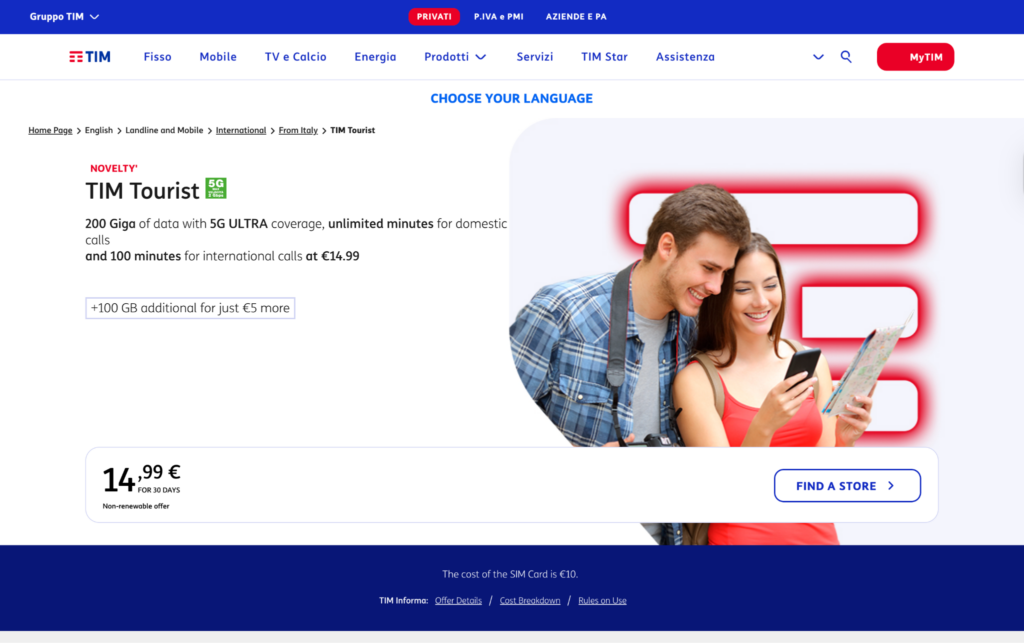
Caption: TIM is one of the most recognizable mobile carriers in Italy and is commonly chosen by travelers because of its strong coverage, tourist SIM plans, and widespread availability around major cities like Rome.
Airport kiosks are easier to access right after landing, but prices are often better at carrier stores around the city center.
Verdict:
Local prepaid SIM cards are best for long stays, temporary residents, or travelers who specifically need an Italian local number while in Rome.
Many travelers still rely on international roaming because it requires almost no setup. Your regular number continues working, and in most cases, your phone connects automatically to an Italian network as soon as you land.
The convenience comes at a cost though. Roaming charges can become surprisingly expensive in Rome.
I also came across quite a few travelers saying that international roaming performance in Rome can be inconsistent depending on the carrier you use back home.
Some people reported perfectly stable connections throughout Italy, while others experienced slow speeds, weak indoor coverage, or difficulty loading maps in crowded tourist areas.
A lot of travelers seemed to agree that local Italian networks like TIM, Vodafone Italy, and WindTre generally performed more reliably than some international roaming plans.
Most roaming charges are usually structured through these pricing models:
To avoid excessive roaming charges while in Rome, I’d recommend:
Verdict:
International roaming only really makes sense for very short trips, layovers, or emergency situations where convenience matters more than keeping costs low.
Pocket WiFi works like a portable router that connects to Italian cellular networks and broadcasts a WiFi signal to your devices.
Instead of activating data on your phone itself, you carry the device with you and connect through WiFi throughout the day.
I can understand why some travelers still rent Pocket WiFi in Rome, especially when traveling in groups. Since one device can support multiple connections, it can help avoid buying separate plans for every person.
That said, I personally found it less appealing compared to newer options like eSIMs because:
Honestly, because most modern phones now support hotspot sharing, many travelers simply use their phone as the main connection source instead.
Best for:
Families or groups carrying multiple connected devices.
Free public WiFi can be found throughout Rome, especially in hotels, cafés, restaurants, airports, train stations, and tourist-heavy areas around the city. Some museums and public spaces also provide WiFi access for visitors.
The problem is that public WiFi in Rome can be unpredictable. I noticed that speeds often slowed down heavily in crowded areas, and some networks required registrations or timed sessions before you could fully connect.
There’s also the security side to think about. Open WiFi networks are never ideal for handling sensitive information, especially when traveling abroad.
A few things I’d recommend when using public WiFi in Rome:
Best for:
Quick browsing, maps, or casual internet use when needed.
The cost of mobile internet in Rome can vary quite a bit depending on which option you choose and how much data you need during your trip.
Travel eSIMs are usually the cheapest and most convenient for short stays, while roaming and Pocket WiFi can become significantly more expensive over time.
| Option | Typical Cost Per Week |
| eSIM | Around $8 to $28/week |
| SIM | Around $15 to $25/week |
| Pocket WiFi | Around $50 to $100+/week |
| Roaming | Around $35 to $105+/week |
For longer stays or heavier data usage, the price difference between eSIMs, local SIM cards, roaming, and Pocket WiFi can become much more noticeable over time.
You can consume a lot of mobile data, especially if you’re constantly relying on your phone while moving between attractions, checking public transportation routes, translating Italian menus, or searching for places to eat throughout the day.
How much you’ll need mostly depends on your travel style and how connected you plan to be during the trip.
| Usage Type | Typical Activities | Approx. Data Needed |
| Light | Maps, WhatsApp, emails | Around 1 to 2 GB/day |
| Medium | Instagram, browsing, music streaming | Around 3 to 5 GB/day |
| Heavy | Video calls, remote work, hotspot use, streaming | Around 8 to 15+ GB/day |
A few ways I managed to reduce data usage while exploring Rome:
I also noticed that a lot of travelers downloaded offline Google Maps before arriving in Italy, especially because connection quality could sometimes become slower in crowded tourist areas or inside older buildings.
Even with a good mobile plan, having offline navigation ready can still be incredibly useful while exploring Rome.
Yes, your mobile data can work in Rome if your carrier supports international roaming or if you purchase an eSIM or local SIM card for Italy. Just make sure your phone is unlocked and compatible with Italian networks before traveling.
Mobile internet works by connecting your phone to nearby cellular towers through a SIM card, eSIM, or roaming service. In Rome, you can access mobile data through Italian carriers, travel eSIM providers, or your home carrier’s roaming plan.
Free WiFi is commonly available in Rome at hotels, cafés, restaurants, airports, train stations, and some tourist areas around the city. Many accommodations also provide complimentary WiFi for guests during their stay.
For light usage like maps and messaging, around 10 to 20 GB is usually enough for 10 days in Italy. If you stream videos, use hotspotting, or work remotely, you may need 30 GB or more.
Yes, most modern smartphones can access the internet in Italy through roaming, eSIMs, local SIM cards, or WiFi. Your phone usually just needs to be unlocked and compatible with European networks.
The easiest way to avoid roaming charges in Italy is by using a travel eSIM or local prepaid SIM card instead of your home carrier’s roaming service. You can also disable roaming entirely and rely on WiFi when possible.
Many travelers consider TIM one of the best SIM card providers in Italy because of its strong nationwide coverage. Vodafone Italy and Iliad Italia are also popular depending on pricing and data needs.

Our mission is simple: to make sure you never have to ask, “What’s the WiFi password?” again. All our tips come straight from personal experience — because we’d never recommend something we haven’t put to the test ourselves.
Reviews