


Travel Guides
Most people land in China thinking they’ll just tap a card or pay with cash like anywhere else, then realize pretty quickly that doesn’t really work. Even small street vendors use their phones for payments. This guide walks you through how it all works, from apps to cash and cards, and what to set up before you go.


When I landed in China, I assumed I could rely on cash or just tap my card like I usually do. That expectation did not last long. I quickly noticed that many places did not handle payments the way I expected, especially in smaller shops and everyday situations.
I’ve found that paying in China works very differently compared to most countries I’ve visited. Mobile payments are everywhere, and people use them for almost everything. I saw locals scanning QR codes at restaurants, in taxis, and even at street stalls, which made it clear that digital payments are the default here.
In this guide, I will walk you through how payments actually work in China, based on what I experienced. I will cover mobile apps, cards, cash, and practical tips that made things easier for me. I will also show you what to set up before you travel so you are ready from day one.
China is a mobile-first, cashless society. I’ve noticed most people do not reach for cash or cards in daily life. Instead, they rely on their phones for almost every transaction, from buying food to paying for transport or small everyday items.
Mobile payments dominate daily transactions across the country. QR code payments are standard in shops, restaurants, taxis, and street vendors. You simply scan a code or show your own, and the payment is completed in seconds without physical money changing hands.

Cash is still accepted in some places, but it is used far less often than expected. Foreign cards are also not always accepted, especially in smaller businesses. This matters for travelers because traditional payment methods are not always enough. However, having a mobile payment option makes getting around much easier.
The two main payment methods I’ve come across in China are mobile apps. Almost everything runs through them, and I quickly realized I could not get far without using them.
The dominant platforms are Alipay and WeChat Pay. I mainly used Alipay, but I’ve also seen many people rely on WeChat Pay. Both work as all-in-one payment systems built into apps that locals use every day.

Alipay is more payment-focused, while WeChat Pay is integrated into the WeChat messaging app, which people also use for chatting, services, and everyday communication. Both rely on QR codes, which I’ve seen used everywhere.
Here’s how they work in practice:
These apps are used in almost every type of place, including:
In reality, they feel less like “payment apps” and more like everyday infrastructure.
Yes, I’ve tried using both Alipay and WeChat Pay in China. Both apps now support foreign users, which makes it possible to pay without a local bank account.
I was able to link my bank card (Visa) directly to both apps. The setup is fairly simple, but it usually requires passport verification as part of the registration process. Once that’s done, payments work through the same QR code system locals use.
However, there are a few limitations I’ve noticed:
I set up Alipay before I came to China, and I mainly used it for all my payments there. The process was pretty quick, but every step mattered if I wanted it to work properly once I arrived.
After downloading the app, I first went through a setup menu inside Alipay where I chose basic options like language and signed in with my international phone number. Only after finishing this initial setup did I enter the main app interface and went to “Account”.
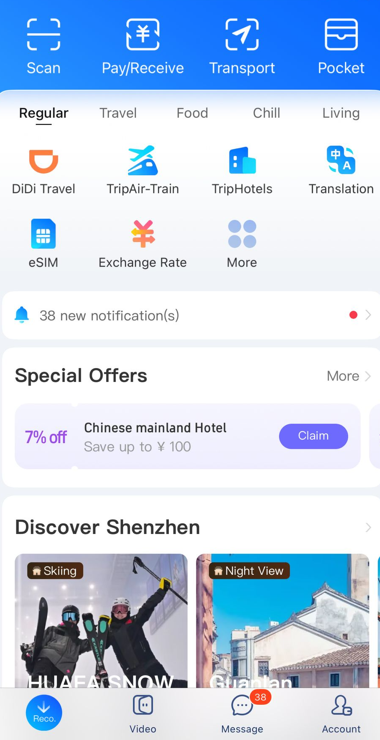
Then I linked my Visa card. I entered the card details inside the “Bank Cards” section, and it was accepted without needing a Chinese bank account. You can also scan your card instead of typing the details manually
After that, I completed passport verification inside the app. I uploaded a photo of my passport and filled in basic details like name and nationality. Without this step, payments didn’t fully activate.
Once verification went through, I had to turn on the payment function inside the app. Only then did QR payments start working properly.
After that, I could:
It basically became my default payment method everywhere I went.
Even though I mainly relied on mobile payments in China, I still came across other payment methods. Cards and cash do exist. However, they felt more like backup options rather than something I could depend on every day.
I was able to use my Visa card in certain places, mostly in:
In these locations, card payments worked without much trouble. However, once I moved outside those environments, things changed quickly.
I found that many smaller businesses did not accept foreign cards at all. In some cases, even when cards were accepted, the payment would fail or not go through. This was more noticeable outside major cities.
Because of that, I would not rely only on a card. It works in some situations, but not consistently enough to be your main payment method.
Cash is still legal and accepted, and I did find places where I could use it. I used it in small corner shops and at local food stalls. I even used it once when paying a taxi driver who did not take mobile payments. But that is not the usual case, since most drivers use mobile payments. It was more useful in smaller shops, local markets, or less touristy areas.
That said, I used cash far less than I expected, especially in cities. Many places clearly preferred mobile payments, and sometimes paying with cash felt slower or less convenient.
What worked for me:
Overall, cash helped in a few situations, but it was not something I relied on regularly.
From my experience in China, mobile payments are the only method I could rely on consistently. I used Alipay for most transactions, and it worked in almost every situation. WeChat Pay works in a similar way, so either option covers most day-to-day spending.
Cash worked as a backup when I needed it, especially in smaller places like local convenience stores or small neighborhood food stalls. I kept some on me just in case, but I did not use it often.
Cards were the least reliable option, and I only used mine in specific places like hotels where international payments were accepted. I could also use them in large stores like Carrefour supermarkets or big international shopping malls in city centers.
Here’s what actually worked for me in real situations:
If I had to keep it simple, I would set up mobile payments first, carry a small amount of cash as backup, and not rely on cards unless I knew the place accepted them.
From my experience in China, payments usually work smoothly. But only if everything is set up properly before you arrive. I quickly learned that preparation matters more than anything else.
First, I set up Alipay before my trip. This saved me time on arrival because everything was already ready to use when I opened the app. I could link my card immediately and complete verification without dealing with language barriers or connection issues on the spot.
I always kept a backup method by carrying a small amount of cash. Also I made sure my card was enabled for international use. I rarely needed them, but they were useful when something failed.
For payments to work, I needed internet access. Either Wi-Fi or mobile data worked. Without it, QR payments simply would not go through. So staying connected was not optional.
Before traveling, I made sure my bank allowed international payments. I checked that this feature was enabled. Without it, linking a card to Alipay would have failed immediately.
Common problems I actually ran into (and how I fixed them)
Mobile payments in China depend heavily on having a stable internet connection. I quickly realized that without data, QR payments do not work at all. Public Wi-Fi exists in some places, but it is not always reliable enough for daily use.
Here are a couple of options:
eSIM
eSIMs are digital SIM cards that activate instantly without needing a physical card or store visit. I used a Holafly eSIM with unlimited data, which made it easy to stay connected right after landing. The newly added “Always On” feature really made the trip less of a headache. Airalo is another option that offers flexible prepaid data plans you install directly on your phone. BNESIM also provides both pay-as-you-go and fixed data options, which can be useful if you want more control over your spending.
Local SIM card
Local SIM cards for China are physical SIMs you can buy at airports or mobile shops after arrival. They are usually affordable and come with data packages for internet access and sometimes calls and texts.The downside is that they require passport registration and a bit of setup, so they are less convenient than eSIMs. I would recommend an eSIM instead, although local SIM cards can still be practical for longer stays.
Pocket WiFi
Pocket WiFi in China creates a portable hotspot that lets multiple devices connect at the same time. They work well if you are traveling in a group or using several devices. However, you need to carry and charge an extra device, and they are often more expensive than eSIM or local SIM card options.
In China, mobile payments are the most widely used method. Apps like Alipay and WeChat Pay dominate everyday transactions. Cash is still accepted in some places, but it is used much less frequently. Foreign credit cards work in limited locations such as hotels, airports, and large stores.
Tourists usually pay with mobile apps like Alipay or WeChat Pay, which allow foreign cards to be linked. I also found that cash can still be used in smaller shops or local markets. Cards are mainly a backup option in larger or international venues.
Yes, US citizens can use Alipay. Foreign Visa and Mastercard cards can be linked to the app after identity verification with a passport. Once set up, it can be used for QR code payments in most places across China.
PayPal is not widely accepted for everyday payments in China. It is mainly used for international online transactions rather than in-store purchases. Most merchants rely on mobile payment apps instead.
No, Cash App is not available or supported in China. Instead, local mobile payment systems like Alipay and WeChat Pay are used for almost all daily transactions.

The best global eSIM provider
From $2.3/week
A reliable eSIM provider for budget travelers
From $2.4/week
The best global eSIM provider
From $2.3/week
A reliable eSIM provider for budget travelers
From $2.4/week
Our mission is simple: to make sure you never have to ask, “What’s the WiFi password?” again. All our tips come straight from personal experience — because we’d never recommend something we haven’t put to the test ourselves.
Reviews